
Every winter, riders split into two camps: those who fire their bike up every few weeks "to keep it healthy," and those who leave it alone until spring. The truth is more nuanced than either side admits. We spoke to the evidence so you can make the right call for your machine.
Key takeaways
What actually happens inside your engine during long-term storage
Before answering the main question, it's worth understanding what winter storage actually does to a motorcycle engine.
When a bike sits unused for weeks or months, engine oil slowly drains from internal surfaces and settles in the sump, leaving metal parts with a thinner film of protection. Fuel in the carburettor bowl or fuel system can degrade and leave gummy deposits. And moisture — always moisture in a British winter — finds its way into places you'd rather it didn't.
The concern most riders are trying to address when they reach for the ignition key is this: they don't want cylinders, bores, camshaft lobes or bearings sitting dry all winter. It's a legitimate worry, especially for air-cooled bikes with tight tolerances and minimal oil film retention at rest.
The other concern is battery health. A motorcycle battery left completely disconnected and unattended over winter will slowly self-discharge, and repeated deep discharges shorten its lifespan. Many riders believe that running the engine for ten minutes will solve this.
Both concerns have merit. The problem is that a brief, cold, stationary startup addresses neither one properly, and can actually make things worse.
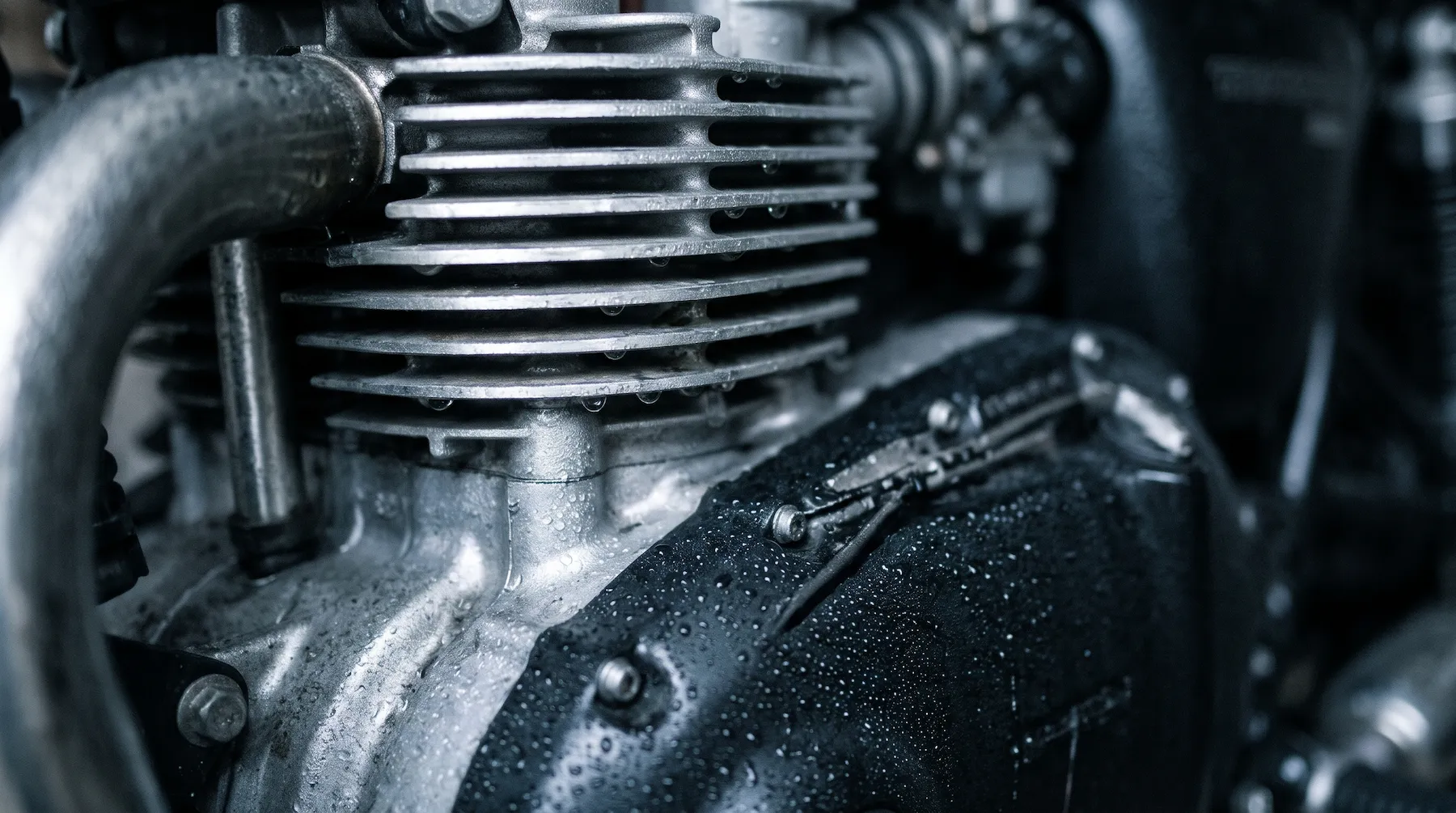
Moisture is the hidden threat during winter storage — and brief cold starts can make it worse.
The case against starting your motorcycle during winter storage
This is where the expert consensus has shifted in recent years, and it's worth taking seriously.
Combustion produces water, and short runs trap it inside
Every time a petrol engine fires, the combustion process produces water vapour as a byproduct. When a fuel-air mixture burns, the hydrogen atoms in the fuel combine with oxygen in the intake air to produce water — a well-understood piece of chemistry. On a fully warmed engine, that water exits as steam through the exhaust. On a cold engine running for only a few minutes in a garage, it doesn't get that chance.
Writing for RevZilla — one of the most authoritative motorcycling publications in the world — Ari Henning makes the point clearly: when riders start their bikes during winter storage, they usually only do it for a few minutes, and running the bike for a brief time doesn't heat everything up enough to prevent condensation. He equates it to the type of short trip that most owner's manuals classify as "severe use," which requires more frequent oil changes.
The steam condenses on cool internal metal surfaces, including valves, bores and exhaust internals. Over repeated short startups across a winter, this moisture can accelerate corrosion in exactly the components you were trying to protect.
Cold startups are the most wear-intensive thing an engine experiences
Cold startups are the most wear-intensive event a motorcycle engine regularly encounters. At the moment of startup, oil pressure has not yet built, oil has drained from bearing surfaces, and tolerances are tighter because metal has contracted in the cold. The first thirty seconds of a cold start is when the overwhelming majority of engine wear occurs.
Harley-Davidson's own service documentation — widely regarded as one of the most detailed sources of engine maintenance guidance in motorcycling — confirms that during cold weather operation, water vapour condenses to liquid form on cool metal surfaces inside the engine, and that in freezing weather this water can become slush or ice, potentially blocking oil lines and causing engine damage.
Adding unnecessary cold starts across a winter storage period compounds this wear without any of the benefit that comes from actually riding.
A brief run won't charge your battery anyway
One of the most common reasons riders start their bikes during storage is to top up the battery. This logic doesn't hold up. Most motorcycle alternators do not produce enough output voltage at idle to charge a battery effectively. At idle, many bikes are simply consuming the charge they're producing, running very close to break-even. A ten-minute idle in the garage will not meaningfully charge a modern motorcycle battery.
The right tool for battery maintenance during storage is a smart battery tender or maintainer, connected overnight or permanently throughout the storage period. Products like the OptiMate range — widely available from UK dealers — desulphate the battery, maintain it at the correct voltage, and will not overcharge it. This keeps the battery in genuinely good condition at a fraction of the inconvenience of periodic startups.
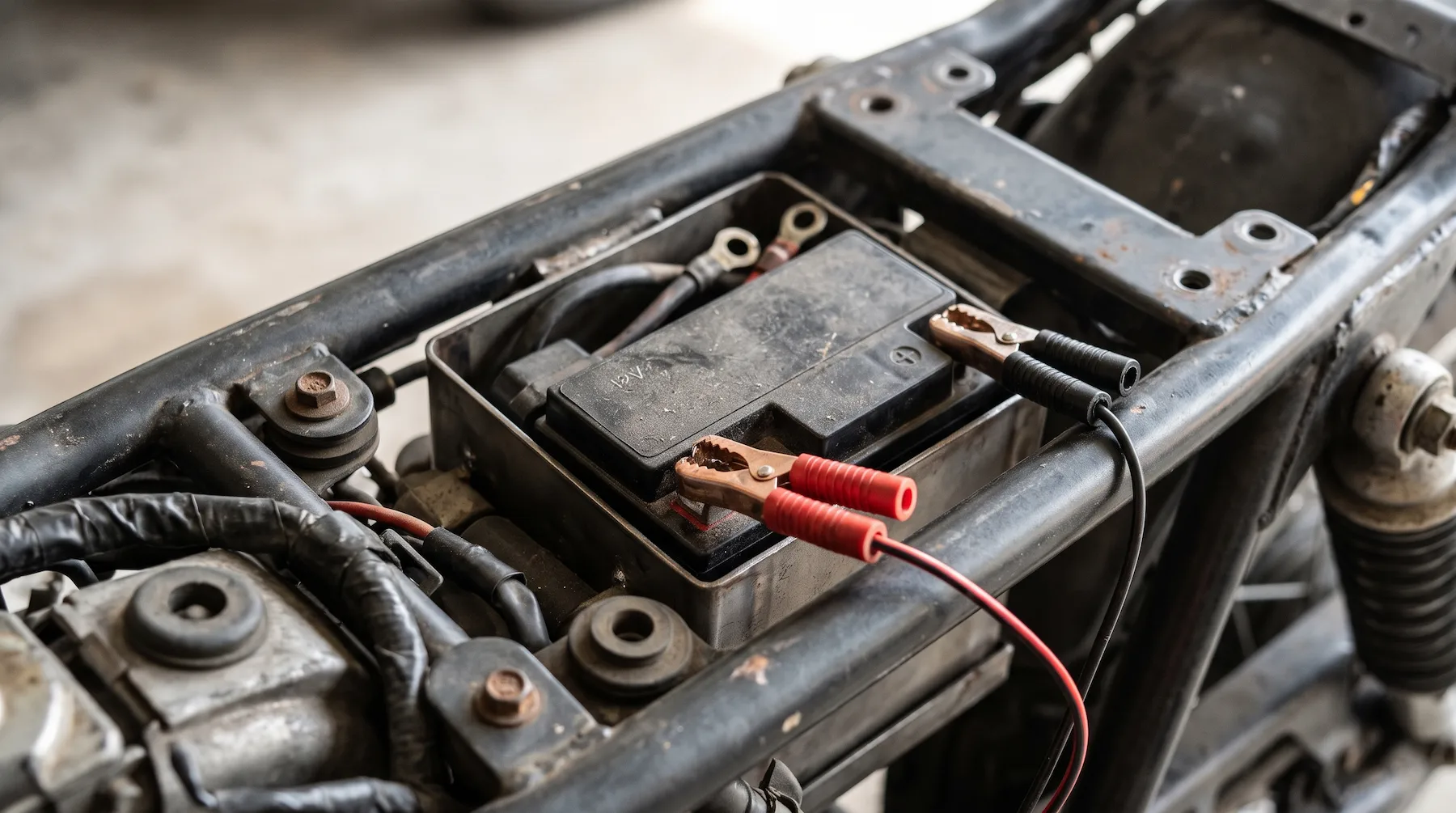
A battery maintainer does far more for your battery than a ten-minute idle ever will.
The case for starting your motorcycle during winter storage (and when it's valid)
The opposing view isn't without merit, and it's important to be balanced.
Hagerty UK — widely respected for their expertise on classic and cherished vehicles — advise that if you don't want to leave the bike forgotten, you can start it every couple of weeks and properly warm it through. The critical phrase there is "properly warm it through." A cursory idle is not the same thing.
If you're going to start your motorcycle during winter storage, the bar you need to clear is full operating temperature. That means the engine needs to reach its normal running temperature, the thermostat needs to have opened on a water-cooled machine, and the exhaust needs to be hot enough to prevent condensation forming inside it. For most bikes in UK winter conditions, that means a minimum of fifteen to twenty minutes of running, and ideally a short ride rather than a stationary idle.
When a periodic startup makes sense
There are circumstances where starting the bike during storage is genuinely reasonable:
- You have access to a private road or driveway and can actually ride the bike for ten or fifteen minutes rather than just idling it. A short ride does what a stationary warm-up cannot: it circulates oil through the full system, heats the gearbox oil, and gets exhaust temperatures high enough to burn off moisture.
- You're running a classic or carburetted bike with an older battery that benefits from a periodic exercise charge. Even so, a smart charger is a better solution.
- The bike will be stored for six months or more and you've done everything else correctly, but want the reassurance of a periodic mechanical check.
- You're checking for new issues, such as an oil leak or unusual noise, that wouldn't be apparent from a visual inspection alone.
In every one of these cases, the starting is incidental to a more substantive maintenance activity. It is not the activity itself.
The right way to prepare your motorcycle for winter storage
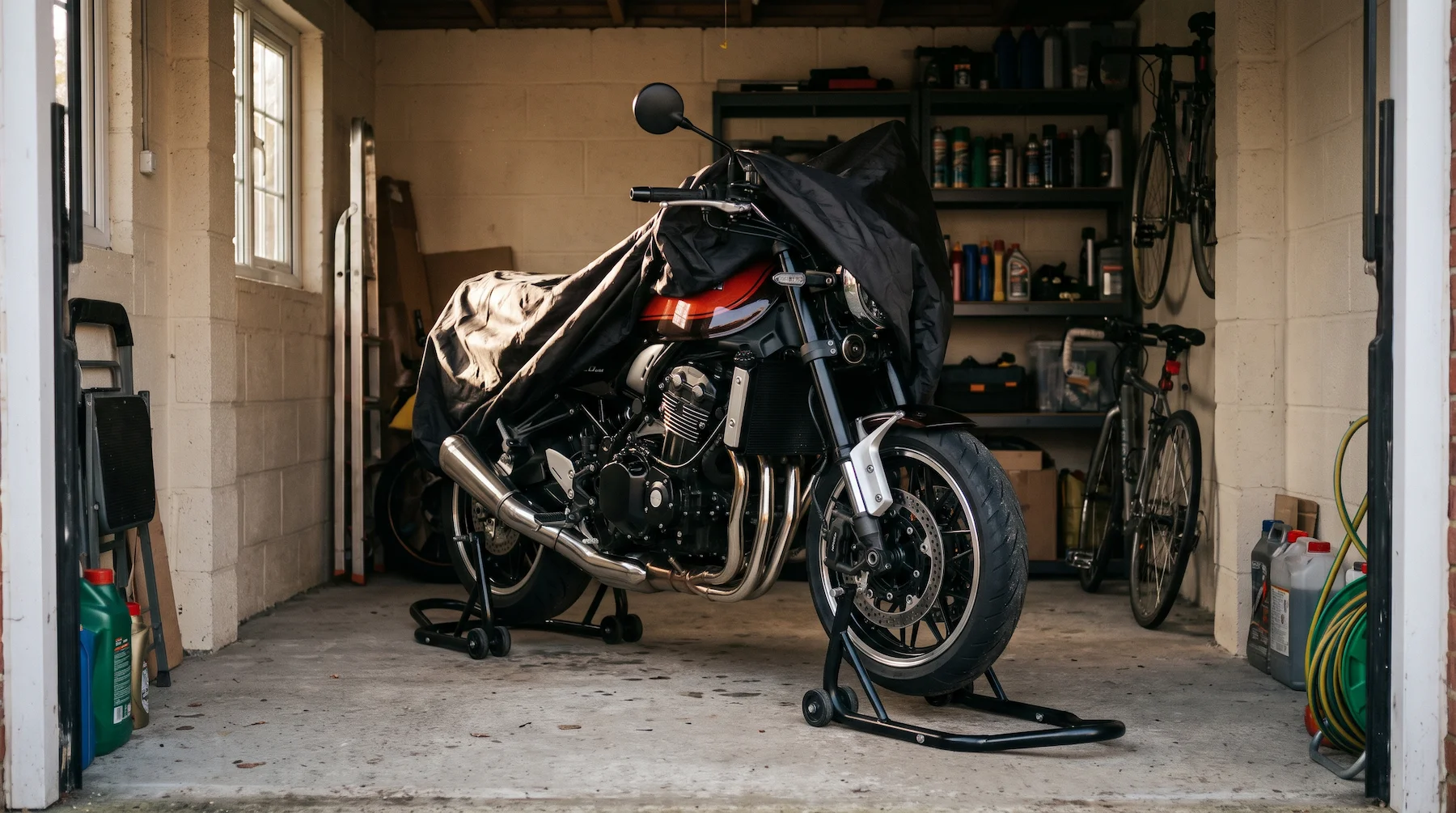
The best thing you can do for your motorcycle during winter is prepare it properly before you put it away, then largely leave it alone.
Change the oil before storage, not after
Engine operation produces combustion byproducts including moisture and acids. Those harmful byproducts can cause problems if left in the engine during storage. Moisture can lead to rust formation on engine parts, and when you fire up the engine in spring, rust particles can flake off into the oil and damage bearings. Fresh oil before storage neutralises this problem. This aligns with Harley-Davidson's own service guidance, which recommends significantly shorter oil change intervals on bikes used only for short, cold-weather trips.
Sort the fuel system
Modern fuel contains ethanol — the E10 blend became the standard petrol grade at UK filling stations in September 2021. Ethanol degrades more quickly than older formulations, can damage older rubber seals, and absorbs atmospheric moisture during prolonged storage.
Add a fuel stabiliser to a full tank of fresh fuel before storage. A full tank limits the air space in which condensation can form. On older carburetted bikes, check your owner's manual about draining float bowls. For bikes stored for more than a few months, consider draining the fuel system entirely, as modern fuel can affect old plastic and rubber components.
Use a smart battery charger, not periodic startups
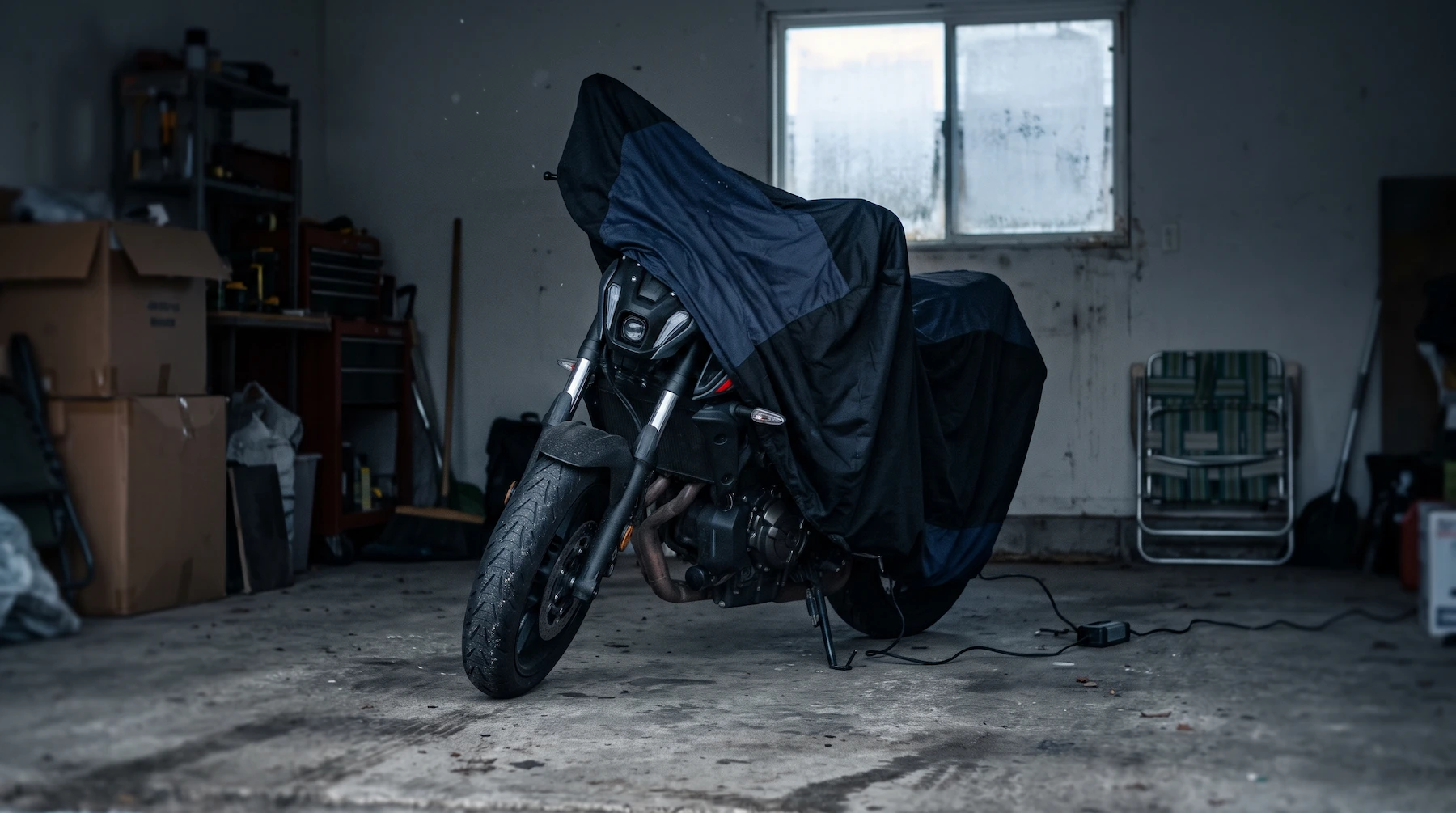
Connect a smart battery maintainer for the duration of the storage period. Units from OptiMate, CTEK and similar manufacturers deliver a conditioning cycle, maintain the battery at the correct charge level, and switch to a float mode when the battery is full. According to motorcycle battery manufacturers, batteries should not sit idle for more than a few weeks at a time. A maintainer solves this without any of the risks associated with cold, brief startups.
Protect against moisture and corrosion
Damp is the main threat during storage, not cold. Clean the bike thoroughly before storage, removing all road salt and grit. Apply a corrosion inhibitor such as ACF-50 to exposed metal surfaces, keeping it away from brake discs and tyres. Raise the bike onto paddock stands to take weight off tyres and prevent flat-spotting during prolonged storage.
Seal entry points against pests
Air box openings and exhaust ends are particular favourites for wasps building nests. Seal these with cloth bungs or foam plugs. Leave a clear visual reminder — a note taped to the handlebars — so you don't forget to remove them before starting in spring.
What about SORN and insurance during winter storage?
If you're taking your bike off the road for the winter, you have an important decision to make about how it's insured.
Once your motorcycle is registered as SORN (Statutory Off-Road Notification) with the DVLA, you are not legally required to have motorcycle insurance as long as it remains off the road. However, being legally exempt from insurance and being sensibly protected are two different things. A SORN bike in a garage is still at risk from fire and theft.
Motorcyclists storing their bikes for winter can inadvertently leave themselves unprotected if they simply declare SORN without reviewing their insurance position. Motorcycle News has reported cases where riders found their standard policy did not cover a SORNed bike for theft — a gap they only discovered when they needed to make a claim.
This is where laid up insurance comes in. If you have declared the bike as SORN, you can insure it under a laid up fire and theft policy. These policies are specifically designed for bikes that are stored and not ridden, covering fire and theft at a significantly reduced premium compared to a standard policy. If you store more than one machine, a specialist multi-bike insurance policy can be a more cost-effective way to cover your collection.
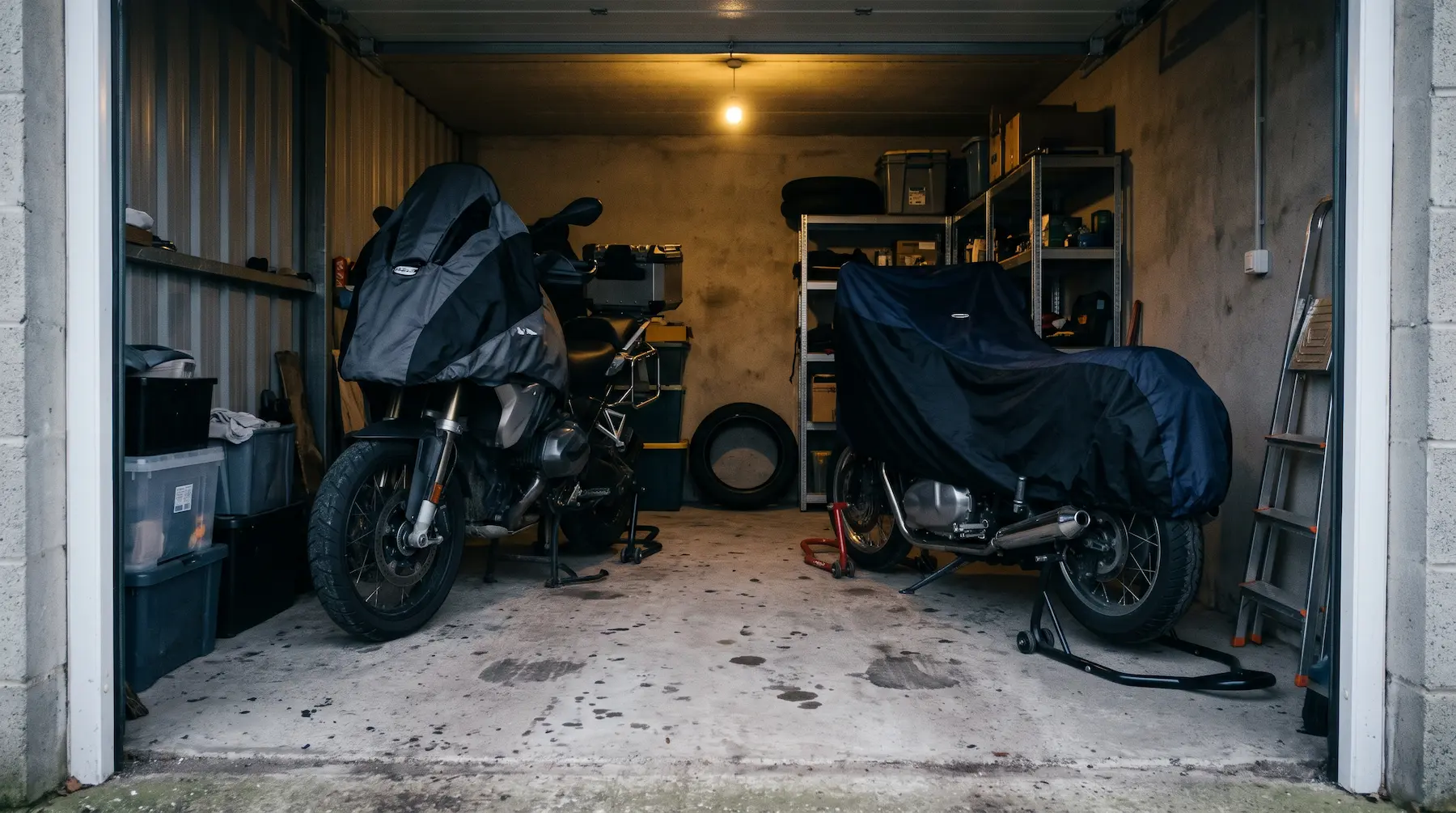
If you store more than one machine, the insurance decisions matter more, not less.
Storing for winter? Don't leave your bike unprotected.
A laid up fire and theft policy costs a fraction of your standard premium and covers your bike against theft and fire while it's off the road. If you're declaring SORN this winter, it's worth a look.
Frequently asked questions
How long can a motorcycle sit without being started?
A properly prepared motorcycle can sit unstarted for the entire winter without issues. The key phrase is "properly prepared": fresh oil, treated fuel, battery on a maintainer, and stored in a dry environment. Many owners go four to five months without starting their bikes and have no problems come spring.
Does idling a motorcycle charge the battery?
Not reliably. Most motorcycles need to be above idle speed for the alternator to produce meaningful charging current. A stationary idle in a garage will not replace the energy consumed by starting the engine, and certainly won't bring a depleted battery back up to full charge. Use a battery maintainer instead.
Is E10 fuel bad for stored motorcycles?
E10 fuel, the standard petrol blend now sold at UK filling stations, contains up to ten percent ethanol. Ethanol absorbs moisture from the air and degrades more quickly than pure petrol. For winter storage, use a fuel stabiliser rated for ethanol-blended fuels. If your bike is an older classic with original rubber seals, check compatibility with your manufacturer or a specialist.
Should I start my motorcycle every week in winter?
The expert consensus says no, unless you can ride it for at least fifteen to twenty minutes to bring the engine and oil fully up to operating temperature. Short, weekly idling sessions cause more harm than good through moisture accumulation and unnecessary cold-start wear.
What is the best temperature to store a motorcycle?
A cool, dry, well-ventilated space is ideal. Extreme cold (consistently below -10°C) can affect some lubricants and seals, but typical UK winter garage temperatures are not a problem if the bike is properly prepared. The main threat is damp, not cold. A dehumidifier maintaining humidity around 55% is effective in a sealed garage.
Can I leave my motorcycle outside during winter storage?
It's not ideal, but it can be managed. Use a high-quality, breathable, waterproof cover designed specifically for motorcycles. Condensation under a non-breathable cover is a significant corrosion risk. Secure the cover to prevent wind damage, and position the bike so water drains away from it. Inside storage is always preferable.
Do I need insurance if my bike is SORN?
Once registered as SORN, you are not legally required to insure the bike. But a laid up fire and theft policy covers your bike against fire, theft and accidental damage while in storage, at a significantly lower cost than a standard policy. It's a sensible step for any bike left unridden for weeks or months.
The verdict: should you start your motorcycle during winter storage?
The honest answer is: only if you're prepared to do it properly.
A quick ten-minute warm-up in the garage, done every few weeks because it feels like you're doing something helpful, is not protecting your engine. It's adding cold-start wear cycles, introducing moisture that may not fully burn off, and failing to charge your battery. The intent is good. The execution, done that way, is counterproductive.
If you can ride the bike for fifteen to twenty minutes, bringing it fully up to operating temperature, that is a different matter. That is a genuine maintenance run. It clears moisture, circulates fully warmed oil, exercises the engine under load, and gives you the chance to notice anything new. But then it's really a short winter ride, not a storage practice.
The best outcome is a properly winterised bike, left alone on a battery maintainer, stored dry, with fresh oil and treated fuel. When spring arrives, it will start first time and be in better condition than one that was periodically fired up and left to cool in a damp garage all winter.
Do the preparation. Trust the preparation. And enjoy the anticipation.
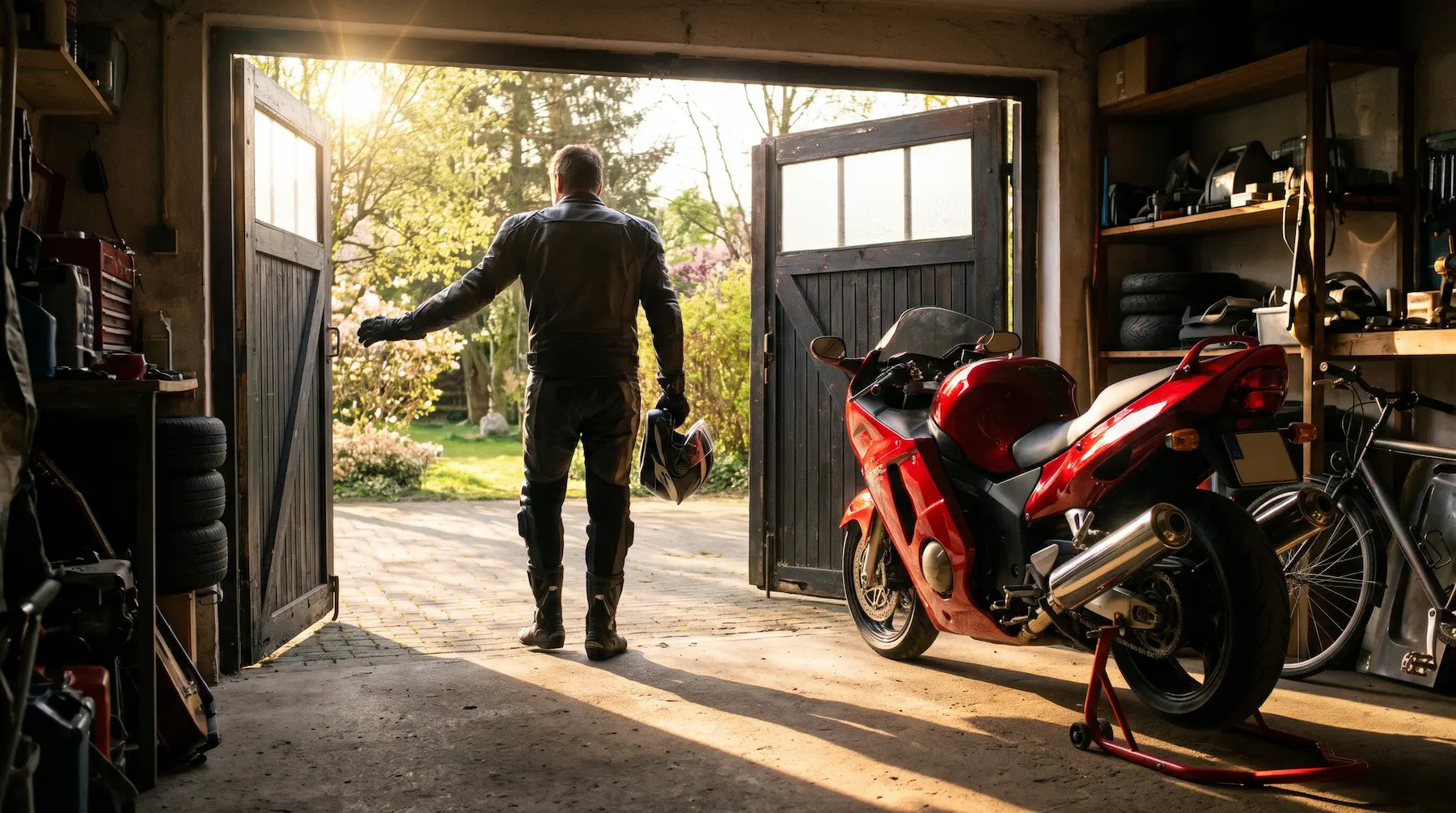
Get the winter right and that first spring morning is exactly this.
Sources and further reading
- Ari Henning, RevZilla Common Tread — The winter storage myth that hurts your motorcycle (2024)
- Iain Macauley, Hagerty UK — Storing and caring for your motorcycle during winter (2020)
- Motorcycle News — How to prepare your motorbike for winter storage
- BlackCircles — Motorcycle winter storage guide
- DVLA — How to make a SORN declaration
- IAM RoadSmart — Prepare your motorcycle for the colder months