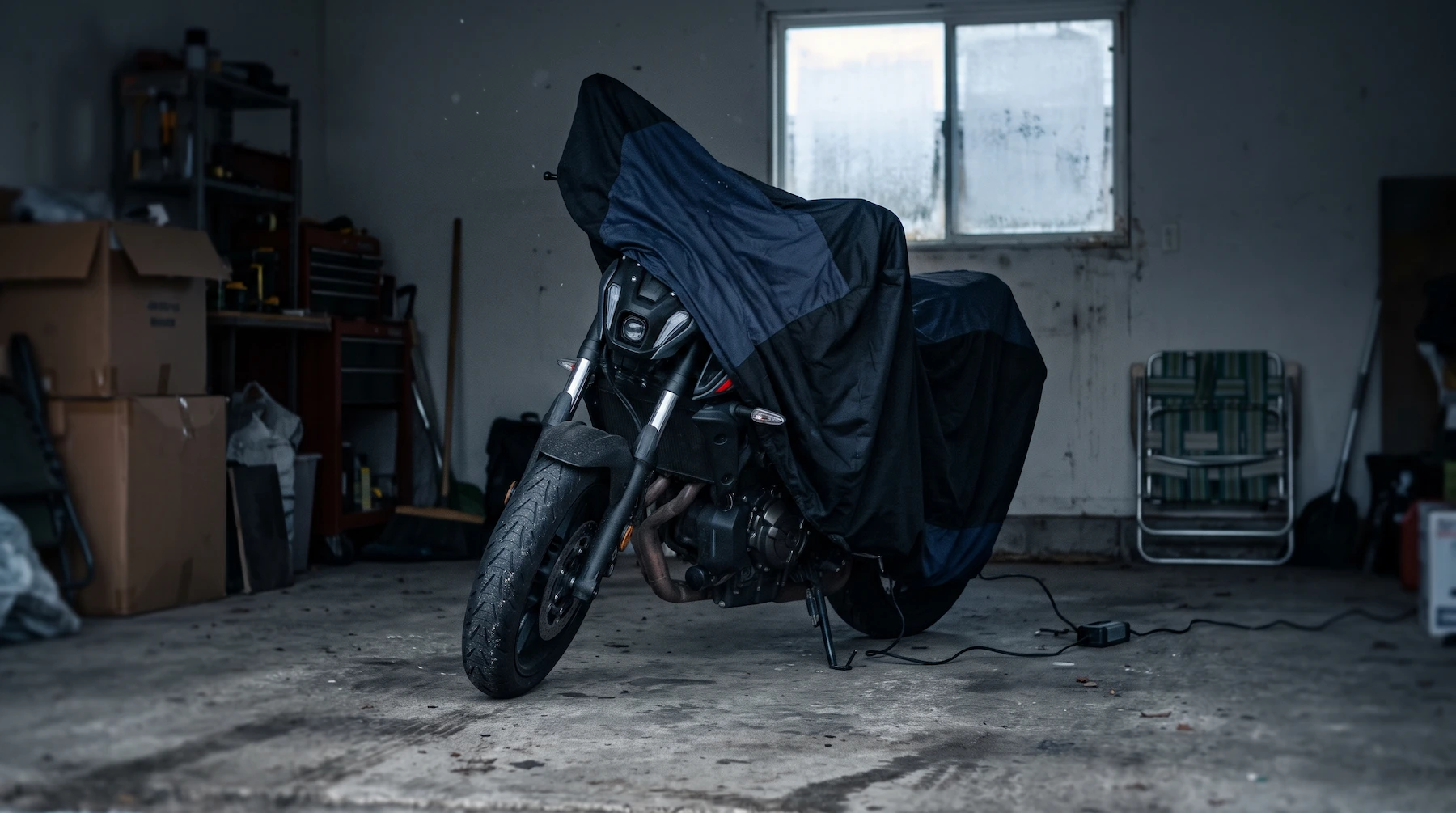

Knowing how to store your motorbike for winter properly is the difference between a bike that fires up first time in spring and one that greets you with flat tyres, a dead battery and a film of corrosion. Whether you ride a sportsbike that stays garaged from November to March or a commuter you're resting for a few weeks over Christmas, the preparation is the same. This guide walks you through every step, from the first wash to the insurance decisions most riders overlook.
Key takeaways
Why proper winter storage matters
It is tempting to think that putting a bike away for winter is as simple as parking it in the garage and throwing a cover over it. It isn't. A motorcycle left without preparation is exposed to a slow accumulation of damage that you won't see until spring.
Moisture is the main threat during a British winter, not cold. Damp air finds its way into engine internals, electrical connections, brake calipers and anywhere else metal meets metal. Road salt left on surfaces eats into chrome and alloy. Oil that has been sitting for months degrades, leaving acids in contact with bearings and cylinder walls. Fuel breaks down, particularly E10 ethanol blends, which absorb atmospheric moisture and can damage older rubber seals.
The good news is that none of this is difficult to prevent. A few hours of preparation before you put the bike away will save you a morning of frustration and potentially a significant repair bill in spring. Everything in this guide is straightforward, and most of it can be done on a driveway with basic tools.
Step one: clean your motorcycle before storing it
This is the foundation of everything else. Never put a bike away dirty. Road salt, grime, dead insects and chain lube residue all hold moisture against metal surfaces, and that moisture is what starts corrosion during a long lay-up.
Give the bike a thorough wash with a dedicated motorcycle cleaner or warm soapy water. Pay particular attention to the underside of the frame, behind the radiator, around the brake calipers and under the mudguards. These are the areas where road salt collects and where corrosion does the most damage out of sight.
Dry the bike completely when you're done. A motorcycle-specific blower dryer is ideal, but a leaf blower or clean microfibre cloths will do the job. Any water left sitting in bolt heads, switch housings or frame joints becomes the corrosion problem you were trying to avoid.
If you have a chain-driven bike, clean and lubricate the chain after washing. The chain will be easier to work with when warm, so consider doing this after a short ride home from your last trip of the season.
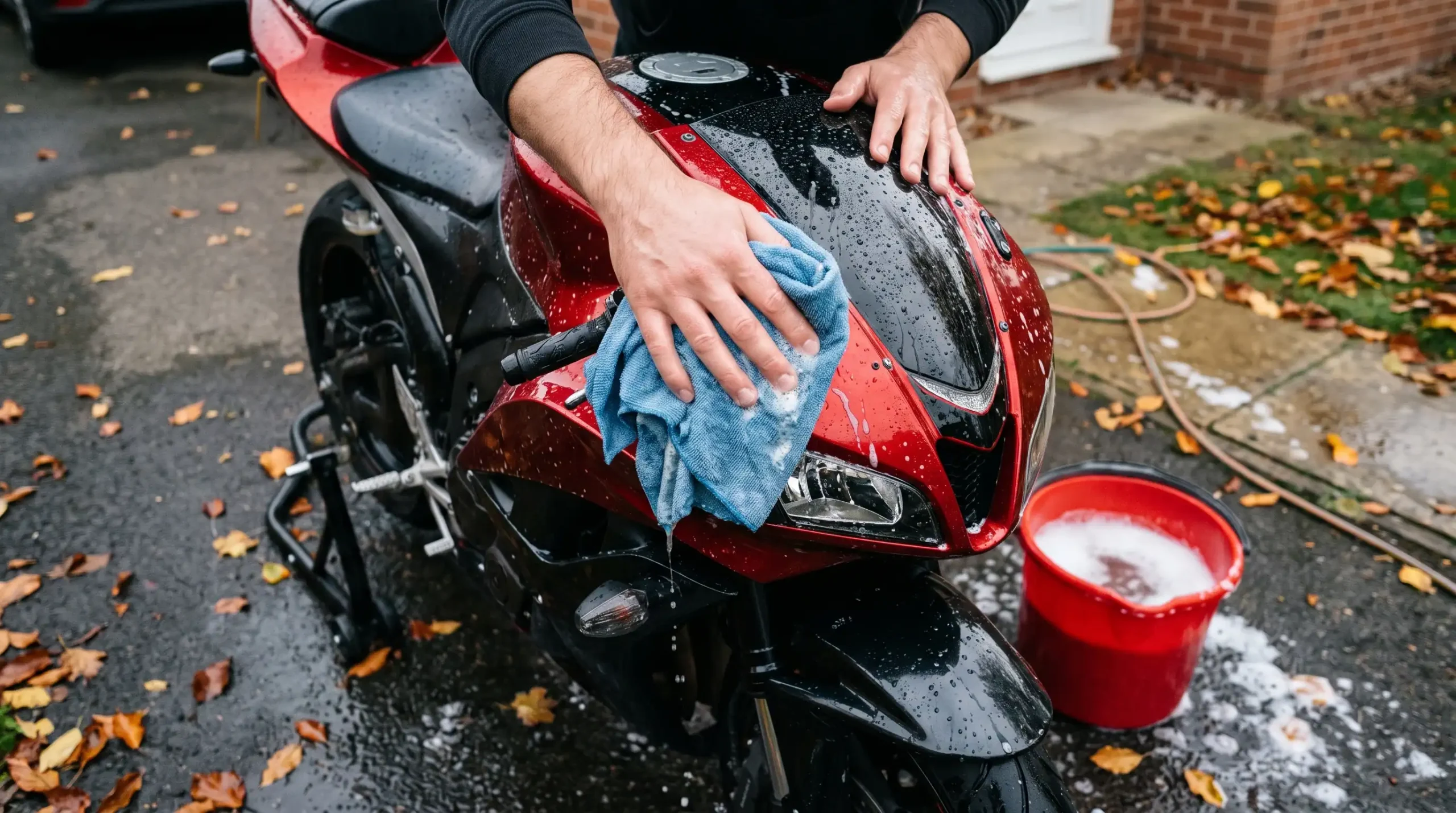
Never put a bike away dirty — road salt and grime hold moisture against metal.
Step two: change the oil and check your fluids
This is the step most riders get backwards. The instinct is to change the oil when you bring the bike out in spring. The right time to do it is before you put it away.
Used engine oil contains combustion byproducts, including moisture and acids. Left sitting against engine internals for three or four months, those contaminants can cause corrosion on bearing surfaces and cylinder walls. Fresh oil before storage neutralises this risk and gives your engine the cleanest possible environment to sit in over winter.
Change the oil filter at the same time. There is no point putting clean oil through a dirty filter.
While you're at it, check the coolant on liquid-cooled bikes. Antifreeze protects the engine from freezing on cold nights, so make sure it's in date and mixed to the ratio set out in your owner's handbook. If the coolant is old or the concentration is weak, top it up or replace it. A frozen cooling system can crack an engine casing.
Brake fluid is worth a visual check too. If it's dark or hasn't been changed in two years, consider replacing it before storage. Brake fluid absorbs moisture over time, and that moisture can corrode brake cylinders and pistons from the inside.
Step three: sort the fuel system
Modern fuel doesn't last as well as it used to. Since September 2021, the standard petrol grade at UK filling stations has been E10, which contains up to ten percent ethanol. Ethanol degrades more quickly than older formulations, absorbs atmospheric moisture, and can damage rubber seals and fuel lines on older bikes.
The simplest approach for most riders storing a bike for three to four months is to fill the tank with fresh fuel and add a quality fuel stabiliser. A full tank limits the air space inside in which condensation can form, and the stabiliser slows down the chemical degradation of the fuel.
On older carburetted bikes, check your owner's handbook. Some manufacturers recommend draining the float bowls for long-term storage to prevent gummy deposits forming inside the carburettor bodies. For bikes stored for longer than a few months, consider whether draining the fuel system entirely is the safer option.
If your bike is a classic with original rubber fuel lines, it is worth checking those lines for cracking or swelling. E10 fuel is harder on older rubber compounds, and a winter of sitting in contact with ethanol-blended fuel can accelerate deterioration.
Step four: look after the battery
A flat battery is the single most common winter storage problem. IAM RoadSmart confirms that flat batteries remain the number one cause for motorcycle recovery services during winter, and it's entirely avoidable.
Even when the bike is switched off, alarms, trackers and clocks slowly drain the battery. Cold weather makes things worse by reducing the battery's ability to hold charge. Left unattended for three or four months, most motorcycle batteries will be dead or significantly degraded by spring.
The right solution is a smart battery maintainer. Products from OptiMate, CTEK and similar manufacturers deliver a conditioning cycle that desulphates the battery, maintains it at the correct voltage, and switches to a float mode when it's full. Connect it permanently throughout the storage period and forget about it.
If you can't keep a maintainer connected, the alternative is to disconnect the battery entirely or remove it from the bike and store it somewhere dry and above freezing. A fully charged battery will hold enough charge to survive a typical UK winter if disconnected, though it won't be in as good condition as one that's been actively maintained.
What you should not do is periodically start the bike to "charge" the battery. Most motorcycle alternators do not produce enough output at idle to meaningfully charge a battery, and the brief cold start introduces other problems. A maintainer is cheaper, easier and far more effective.
Step five: protect the tyres and suspension
Tyres are easy to overlook when a bike is laid up, but months of standing weight in one position can cause flat spots. A flat spot forms where the tyre contacts the floor, and over a full winter the rubber can deform permanently. At best, you'll feel a vibration on the first few rides of spring that gradually works itself out. At worst, the tyre is damaged and needs replacing.
The best prevention is to get the bike up on paddock stands, front and rear, so there is no weight on the tyres at all. If you only have a rear stand, that's still better than nothing. If you don't have any stands, inflate the tyres to the upper end of the manufacturer's recommended range before storage. Some riders place a piece of carpet or plywood between the tyres and a cold concrete floor to insulate against temperature fluctuations.
If the bike is staying on its wheels, try to rotate them every few weeks to change the contact patch. This is much easier if the bike is on its centre stand.
Fork seals can dry out during prolonged storage. A light coating of silicone spray on the exposed fork stanchions helps keep the seals supple and reduces the risk of leaking when you start riding again in spring.
Step six: apply corrosion protection
Once the bike is clean and dry, it's time to give it a layer of protection that will last all winter.
ACF-50 is the product most UK riders reach for, and for good reason. Originally developed to protect military aircraft from corrosion, it forms an ultra-thin, clear film that kills existing corrosion cells and prevents new ones from forming. It is safe on paint, chrome, plastics, rubber and electrical connections. A single application lasts up to twelve months.
Apply it after the bike is completely clean and dry, using the aerosol with an extension nozzle to reach into tight spaces around the engine casings, behind the radiator, under the frame rails and around electrical connectors. Keep it away from brake discs, brake pads and tyre contact surfaces. A light mist is all you need. ACF-50 has strong capillary action and will creep into the gaps where moisture would otherwise settle.
If you prefer an alternative, XCP Rust Blocker and Scottoiler FS 365 are both popular with UK riders and do a similar job. Whichever you use, the principle is the same: a protective film between the metal and the moisture that will inevitably be in the air over a British winter.
Wax exposed paintwork and polish chrome or stainless surfaces. This creates an additional barrier against moisture and means the bike will need less cleaning when you bring it out in spring.
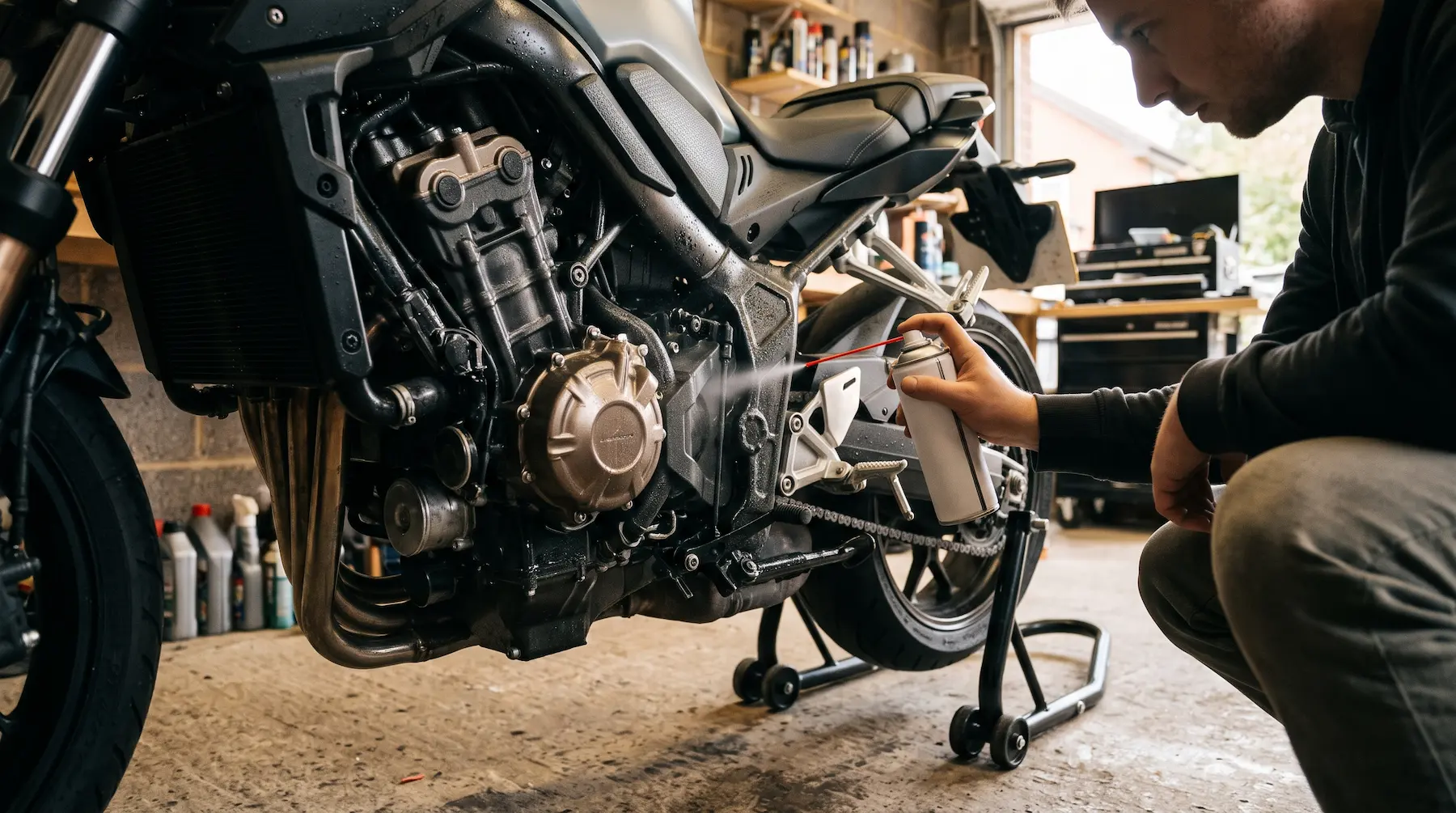
ACF-50 or a similar corrosion inhibitor creates a protective film that lasts all winter.
Step seven: choose the right storage location
Where you store the bike matters as much as how you prepare it. The ideal is a dry, well-ventilated indoor space. A residential garage or dry shed is what most UK riders have available, and it works well if you manage the moisture.
The main threat indoors is condensation. Temperature fluctuations cause moisture to condense on cold metal surfaces, even inside a garage. A small plug-in dehumidifier set to maintain humidity around 50 to 55 percent is one of the most effective things you can do for a stored bike. If that isn't practical, moisture-absorbing tubs placed around the bike will help.
Use a breathable motorcycle cover, even indoors. It keeps dust off the bike and provides a buffer against condensation. Avoid non-breathable plastic covers or tarpaulins. These trap moisture underneath and can accelerate corrosion rather than prevent it.
If you don't have a garage, there are still workable options. A solid garden shed with good ventilation, a dedicated motorcycle storage unit from a specialist provider, or even a heavy-duty outdoor motorcycle cover on a hard-standing area will all serve. Outdoor storage is not ideal, but a good breathable, waterproof cover secured properly against wind is far better than nothing.
Block exhaust outlets and air box openings with cloth bungs or foam plugs. These are favourite nesting spots for wasps and rodents over winter. Leave a clear reminder on the handlebars so you don't forget to remove them before starting in spring.
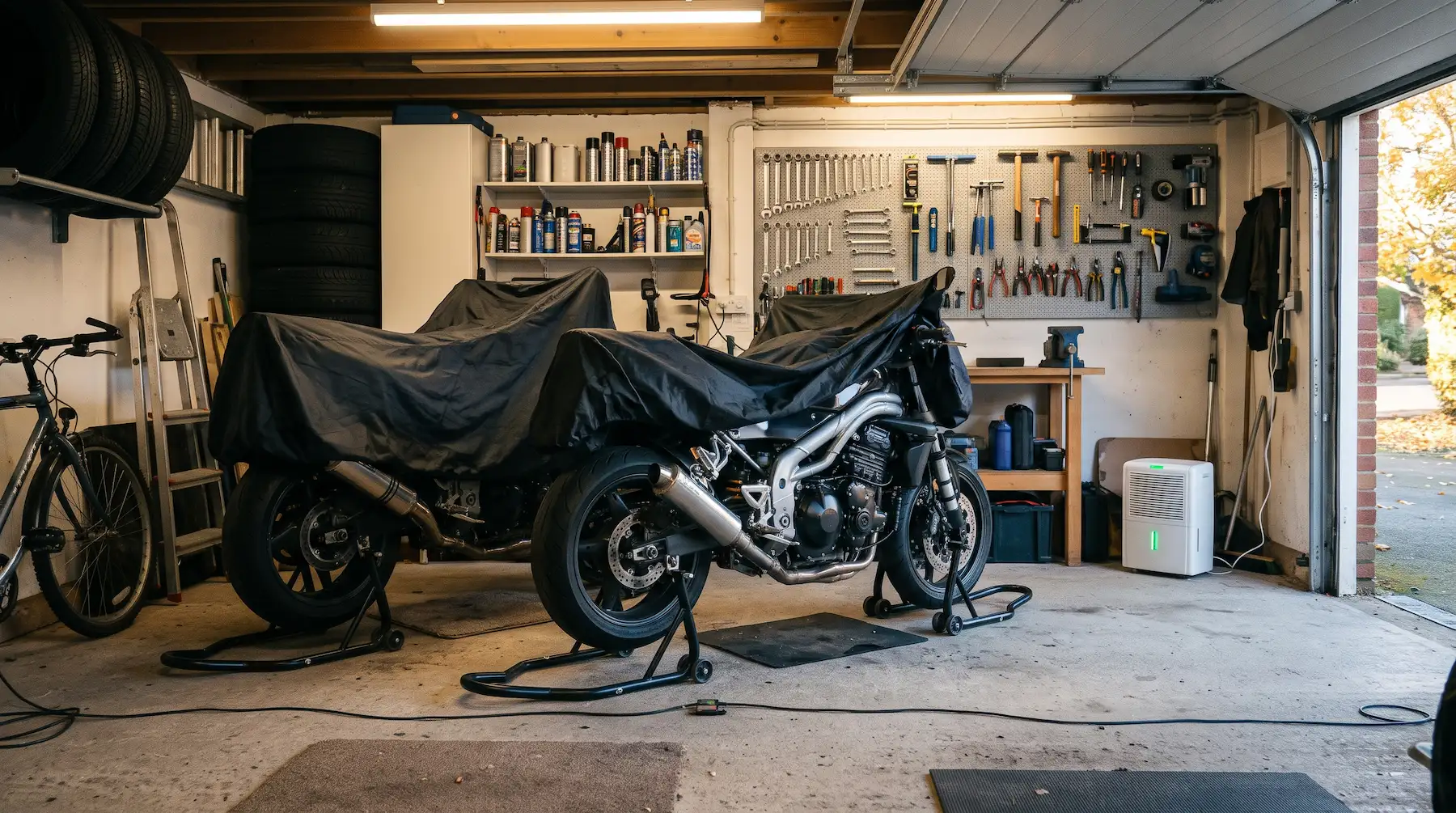
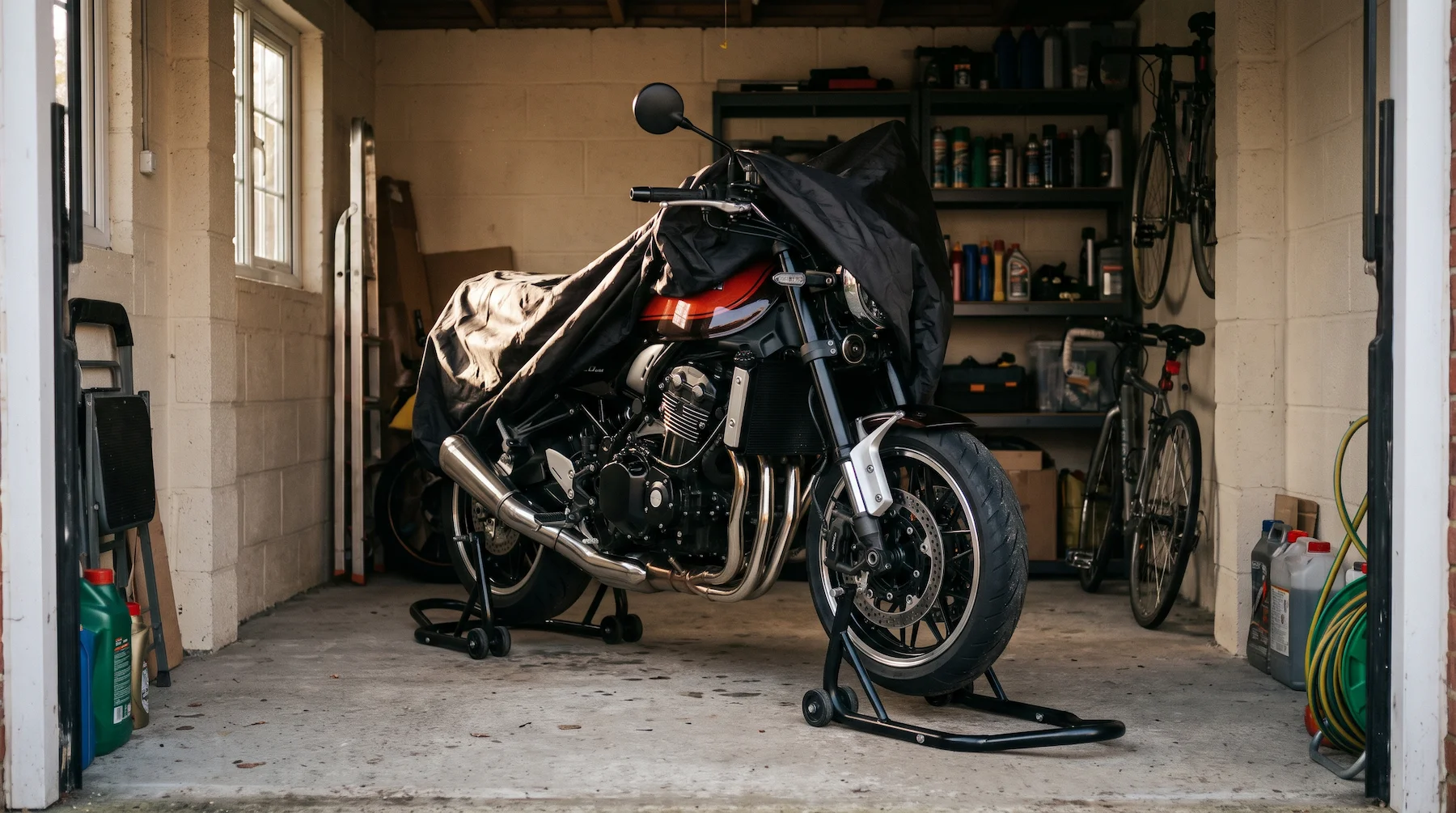
A dry, well-ventilated garage with a dehumidifier is the gold standard for winter storage.
Step eight: don't forget security
A bike sitting in a garage all winter is a sitting target. Thieves know that garages are full of motorcycles between November and March, and a bike that isn't going to be ridden for months may not be missed immediately if it disappears.
Use a quality chain and ground anchor, even in a locked garage. A disc lock is a visible deterrent but should not be your only security measure. If you have more than one bike stored, chain them together and to a fixed anchor point.
Consider a GPS tracker if you don't already have one fitted. Many modern trackers are battery-powered and will alert your phone if the bike is moved. This is particularly valuable if you're storing a bike away from home, in a rented unit or shared space.
Check that your garage or shed locks are in good condition. A five-lever deadlock on a solid door is a minimum. If you have windows, consider boarding them or fitting security film to prevent casual break-ins and to keep the contents out of sight.
Get the Winter Storage & Spring Checklist
Every step from this guide in a printable one-page checklist you can tape to your garage wall. Covers winterisation prep, storage checks, and the full spring recommissioning list so nothing gets missed.
Check your inbox
We've sent the Winter Storage & Spring Checklist to your email. If it doesn't arrive in a few minutes, check your spam folder.
SORN, insurance and the gap most riders miss
If you're taking your bike off the road for the winter, you have an important decision to make about how it's insured. This is the step that catches people out.
Once your motorcycle is registered as SORN (Statutory Off-Road Notification) with the DVLA, you are not legally required to have motorcycle insurance. But being legally exempt and being sensibly protected are two different things. A SORN bike in a garage is still at risk from fire and theft.
Motorcycle News has reported cases where riders found their standard policy did not cover a SORNed bike for theft, a gap they only discovered when they needed to make a claim. Some policies automatically lapse or exclude cover once a bike is declared SORN, even if the premium has been paid.
This is where laid up insurance comes in. A laid up fire and theft policy is specifically designed for bikes that are stored and not ridden. It covers fire and theft at a significantly reduced premium compared to a standard policy. If you store more than one machine, a specialist multi-bike insurance policy can be a more cost-effective way to cover your collection.
Before you declare SORN, pick up the phone and check your current policy. Ask specifically whether fire and theft cover continues if the bike is declared off the road. If it doesn't, arrange a laid up policy before the SORN takes effect. It's one of those things that costs very little but matters enormously if the worst happens.
Storing for winter? Don't leave your bike unprotected.
A laid up fire and theft policy costs a fraction of your standard premium and covers your bike against theft and fire while it's off the road. If you're declaring SORN this winter, it's worth a look.
Frequently asked questions
How long can a motorcycle sit without being started?
A properly prepared motorcycle can sit unstarted for the entire winter without issues. The key phrase is "properly prepared." With fresh oil, treated fuel, a battery on a maintainer, and storage in a dry environment, many riders go four to five months without starting their bikes and have no problems come spring.
Should I start my motorcycle every week in winter?
The expert consensus says no, unless you can ride it for at least fifteen to twenty minutes to bring the engine and oil fully up to operating temperature. Short, weekly idling sessions cause more harm than good through moisture accumulation inside the engine and unnecessary cold-start wear. If you've prepared the bike properly, it's better to leave it alone.
Is E10 fuel bad for stored motorcycles?
E10 fuel contains up to ten percent ethanol, which absorbs moisture from the air and degrades more quickly than pure petrol. For winter storage, fill the tank to reduce air space and use a fuel stabiliser rated for ethanol-blended fuels. If your bike is an older classic with original rubber seals, check compatibility with your manufacturer or a specialist.
Do I need insurance if my bike is SORN?
Once declared SORN, you are not legally required to insure the bike. However, a laid up fire and theft policy covers your bike against fire and theft while in storage at a significantly lower cost than a standard policy. Some standard policies won't cover a SORNed bike at all, so check your existing cover before you declare.
Can I leave my motorcycle outside during winter?
It's not ideal, but it can be managed. Use a high-quality, breathable, waterproof cover designed specifically for motorcycles. Condensation under a non-breathable cover is a significant corrosion risk. Secure the cover to prevent wind damage, and position the bike so water drains away from it. Inside storage is always preferable, but a good outdoor cover over a properly prepared bike is far better than a dirty, unprepared bike left in a damp garage.
What is the best temperature to store a motorcycle?
A cool, dry, well-ventilated space is ideal. Typical UK winter garage temperatures are not a problem if the bike is properly prepared. The main threat is damp, not cold. A dehumidifier maintaining humidity around 50 to 55 percent is one of the most effective things you can do in a sealed garage or shed.
How do I stop my motorcycle tyres from flat-spotting?
The best solution is to raise the bike on front and rear paddock stands so no weight rests on the tyres. If you don't have stands, inflate the tyres to the upper end of the manufacturer's recommended range and try to rotate the wheels every few weeks. Placing a piece of carpet or plywood between the tyres and a cold concrete floor also helps.
The bottom line: a few hours now saves a headache in spring
Storing a motorcycle for winter is not complicated, but it does reward thoroughness. The bikes that come out of storage in the best condition are the ones that went in properly prepared: clean, dried, fluids fresh, battery maintained, corrosion protected and stored dry.
The common thread through every step in this guide is moisture. Control the moisture and you control the damage. That means cleaning off the salt that holds it, changing the oil that contains it, filling the tank so condensation can't form in it, maintaining the battery so it doesn't degrade from it, and storing the bike somewhere it can't accumulate.
Sort the insurance before you sort the cover. And when that first dry Saturday arrives in March, your bike will be ready. First press of the starter, engine running, oil clean, tyres round, battery full. That's the reward for doing the work now.
Prepare it properly. Store it sensibly. Ride it in spring.
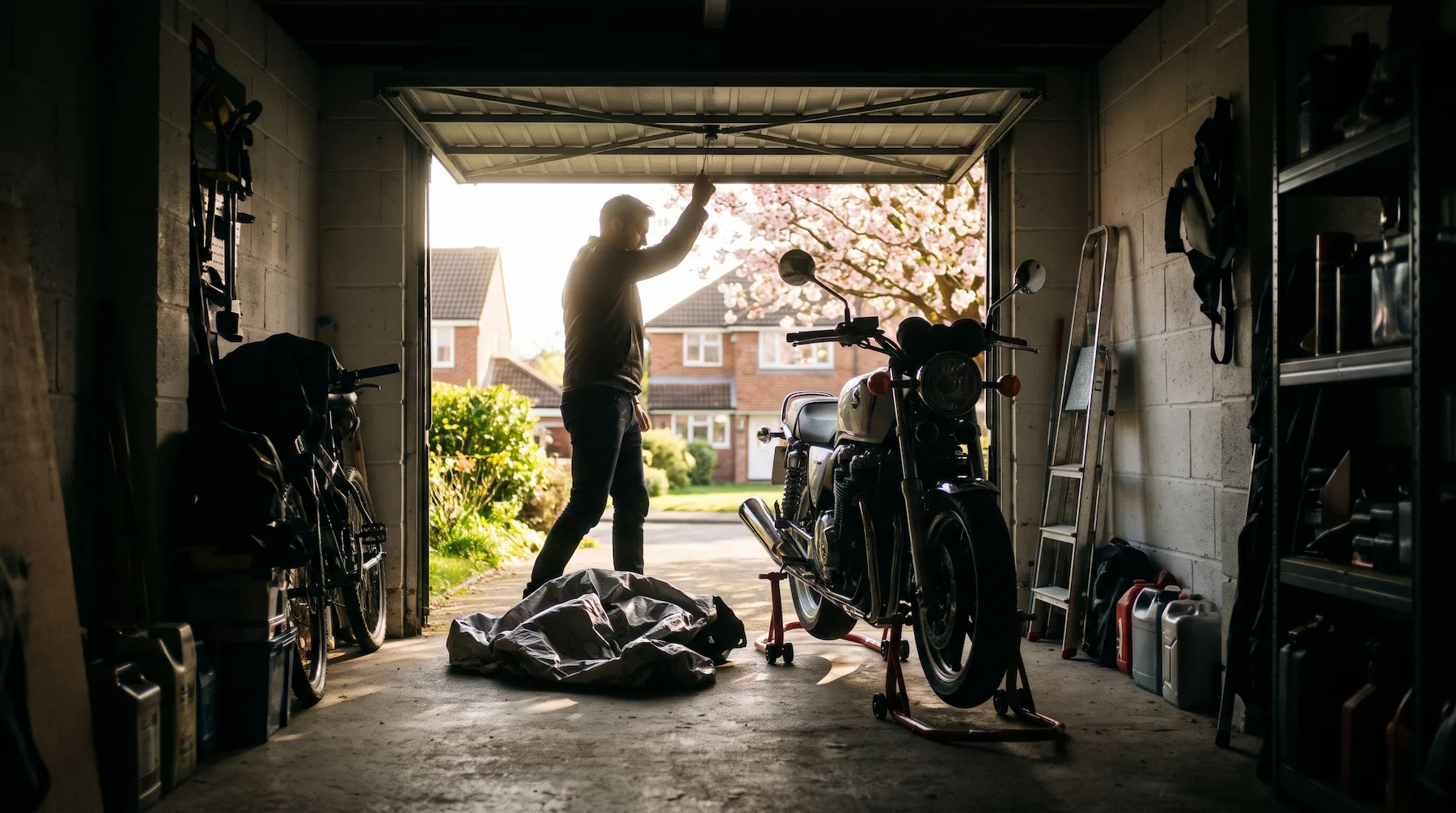
Get the winter right and that first spring morning is exactly this.
Sources and further reading
- Iain Macauley, Hagerty UK — Storing and caring for your motorcycle during winter (2020)
- Motorcycle News — How to prepare your motorbike for winter storage
- BlackCircles — Motorcycle winter storage checklist
- IAM RoadSmart — Prepare your motorcycle for the colder months
- Michelin UK — How to store your motorcycle for winter
- Visordown — How to store your motorcycle in winter
- DVLA — How to make a SORN declaration
- AutoTrader Bikes — How to store a motorcycle over winter