
Want a copy of this guide?
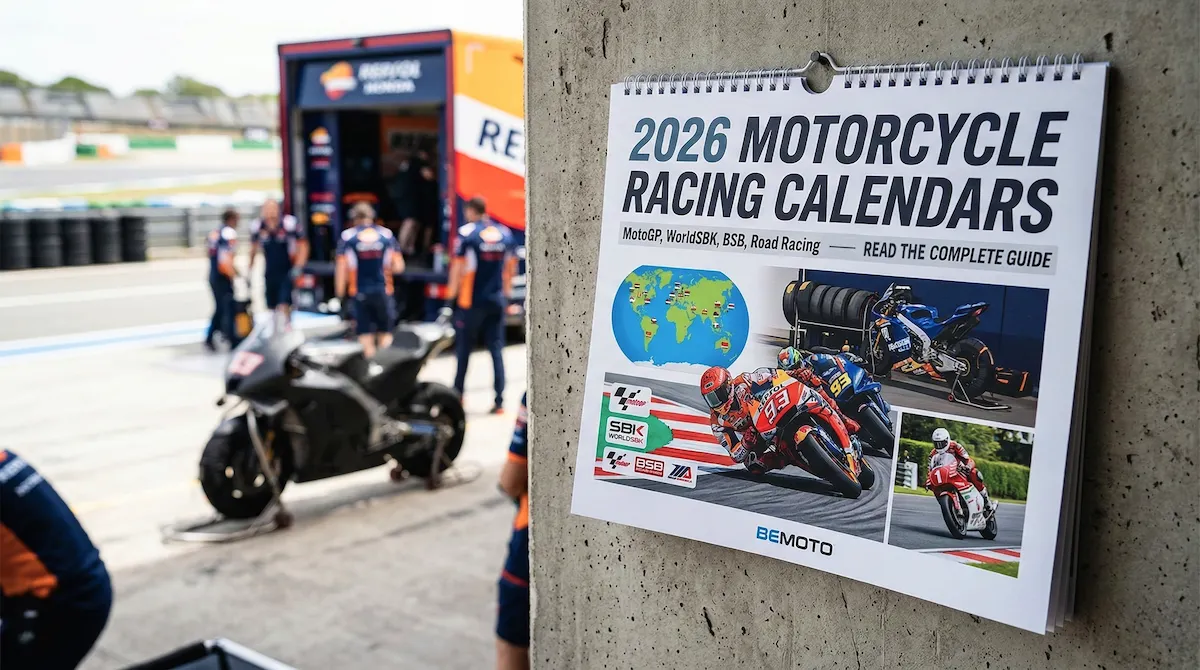
2026 Motorcycle Racing Calendars: Your Ultimate Guide to the Season
If you’re a fan of two-wheeled adrenaline, it’s time to sync your devices and clear your weekends. The 2026 motorcycle racing calendars are shaping up to be some of the most historic in recent memory, featuring milestone anniversaries, returning legendary tracks, and a global tour that spans from the heat of Thailand to the hills of Scotland.
Whether you are booking flights for a MotoGP pilgrimage or planning a camping trip for a BSB round, here is your definitive guide to the 2026 motorcycle racing calendars and every major event on the horizon.
Pro Tip: While many of the dates in these 2026 motorcycle racing calendars are confirmed by the organising bodies, they remain provisional until final ratification. Always check official circuit websites before booking travel!
MotoGP Race Calendar 2026: A Global Odyssey
The MotoGP portion of the 2026 motorcycle racing calendars is more ambitious than ever, featuring a record-breaking 22-round schedule. A major highlight for 2026 is the return of the Czech Grand Prix at Brno and the full integration of the Balaton Park Circuit in Hungary.
| Round | Date | Grand Prix | Circuit | Official Link |
|---|---|---|---|---|
| 1 | 01 March | Thai GP | Chang International | Tickets |
| 2 | 22 March | Brazilian GP | Ayrton Senna | Tickets |
| 3 | 29 March | Americas GP | COTA, USA | Tickets |
| 4 | 12 April | Qatar GP | Lusail Circuit | Tickets |
| 5 | 26 April | Spanish GP | Jerez | Tickets |
| 6 | 10 May | French GP | Le Mans | Tickets |
| 7 | 17 May | Catalan GP | Barcelona-Catalunya | Tickets |
| 8 | 31 May | Italian GP | Mugello | Tickets |
| 9 | 07 June | Hungarian GP | Balaton Park | Tickets |
| 10 | 21 June | Czech GP | Brno | Tickets |
| 11 | 28 June | Dutch TT | Assen | Tickets |
| 12 | 12 July | German GP | Sachsenring | Tickets |
| 13 | 09 August | British GP | Silverstone | Tickets |
| 14 | 30 August | Aragon GP | MotorLand Aragón | Tickets |
| 15 | 13 September | San Marino GP | Misano | Tickets |
| 16 | 20 September | Austrian GP | Red Bull Ring | Tickets |
| 17 | 04 October | Japanese GP | Motegi | Tickets |
| 18 | 11 October | Indonesian GP | Mandalika | Tickets |
| 19 | 25 October | Australian GP | Phillip Island | Tickets |
| 20 | 01 November | Malaysian GP | Sepang | Tickets |
| 21 | 15 November | Portuguese GP | Portimão | Tickets |
| 22 | 22 November | Valencia GP | Ricardo Tormo | Tickets |
BSB Race Calendar 2026: Celebrating 30 Years
The BSB race calendar 2026 is particularly special as the series celebrates its 30th Anniversary (BSB30). It is a vital inclusion in the 2026 motorcycle racing calendars, especially with the return of the "International Showdown" at Assen.
| Round | Date | Venue | Official Link |
|---|---|---|---|
| 1 | 02–04 May | Oulton Park | Tickets |
| 2 | 15–17 May | Donington Park GP | Tickets |
| 3 | 19–21 June | Knockhill | Tickets |
| 4 | 03–05 July | Snetterton 300 | Tickets |
| 5 | 17–19 July | Brands Hatch GP | Tickets |
| 6 | 31 Jul – 02 Aug | Oulton Park | Tickets |
| 7 | 14–16 August | Thruxton | Tickets |
| 8 | 29–31 August | Cadwell Park | Tickets |
| 9 | 18–20 September | Assen, Netherlands | Tickets |
| 10 | 02–04 October | Donington Park GP | Tickets |
| 11 | 16–18 October | Brands Hatch GP | Tickets |
WorldSBK Race Calendar 2026: Production Racing at its Peak
Completing the major 2026 motorcycle racing calendars, WorldSBK continues to offer three races per weekend, starting its tour at Phillip Island before heading to Europe.
| Round | Date | Circuit | Official Link |
|---|---|---|---|
| 1 | 20–22 February | Phillip Island | Tickets |
| 2 | 27–29 March | Portimão | Tickets |
| 3 | 17–19 April | TT Circuit Assen | Tickets |
| 4 | 01–03 May | Balaton Park | Tickets |
| 5 | 15–17 May | Autodrom Most | Tickets |
| 6 | 29–31 May | MotorLand Aragón | Tickets |
| 7 | 12–14 June | Misano | Tickets |
| 8 | 10–12 July | Donington Park | Tickets |
| 9 | 04–06 September | Magny-Cours | Tickets |
| 10 | 25–27 September | Cremona Circuit | Tickets |
| 11 | 09–11 October | Estoril | Tickets |
| 12 | 16–18 October | Jerez | Tickets |
Road Racing & International Events 2026
| Event | Date | Venue | Official Link |
|---|---|---|---|
| North West 200 | 04–09 May | Portrush, NI | Tickets |
| Isle of Man TT | 25 May – 06 June | Isle of Man | Tickets |
Racing Highlights and Ones To Watch in 2026
This year is a historic "bridge" year within the 2026 motorcycle racing calendars, blending the final chapter of 1000cc prototypes with the arrival of a new generation of superstars.
MotoGP: The Final 1000cc Showdown
As 2026 marks the last year of the high-displacement 1000cc prototypes before the 2027 engine shift, expect records to fall as manufacturers extract every last drop of performance.
- Toprak’s Debut: The biggest talking point is Toprak Razgatlıoğlu moving to MotoGP with Pramac Yamaha. His "stoppie" style and late-braking mastery are set to shake up the established order.
- The Marquez Dynasty: Marc Márquez steps into the factory Ducati Lenovo Team alongside Pecco Bagnaia. It’s a battle of the titans that could see Marc equal the all-time title records.
- V4 Yamaha Evolution: Watch for the technical debut of Yamaha’s new V4 engine architecture, a strategic move by the Japanese giant to bridge the gap to the European manufacturers.
WorldSBK & BSB: The Battle for the Production Crown
With the king of WorldSBK moving to MotoGP, the production-based paddocks within the 2026 motorcycle racing calendars are more unpredictable than ever.
- Nicolò Bulega (WorldSBK): Now the lead man at Aruba.it Ducati, Bulega is the clear title favourite, but he faces stiff competition from the experienced Miguel Oliveira on the BMW M 1000 RR.
- The British Return (BSB): For the 30th Anniversary, Scott Redding returns to the British circuits on a PBM Ducati. His rivalry with the consistent Jason O’Halloran (Honda) will be the highlight of the summer rounds.