
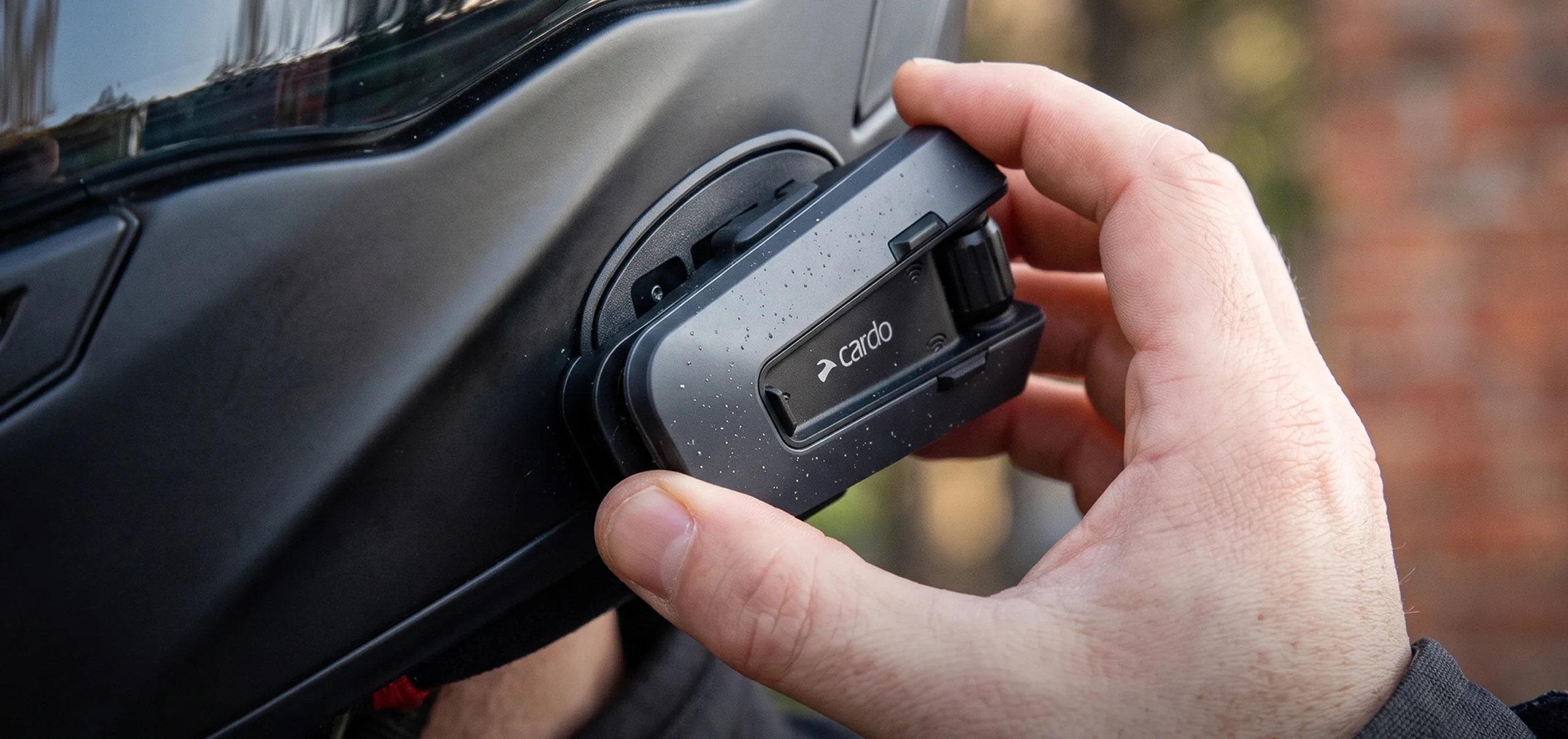
The premium Bluetooth mesh intercom that ditched the antenna, nailed the audio and made helmet comms feel like they finally belong in 2026. We have been testing the Cardo Packtalk Edge across daily commutes, weekend group rides, motorway miles and every shade of British weather for several weeks to give you an honest, real-world verdict.
Key Benefits
What Problem Does It Solve?
If you ride with mates, you already know the frustration. You pull up at a junction, flip your visor, shout something nobody hears, then set off again in silence for another 20 miles. Or you have a pillion who wants to point out the turning you are about to sail past but physically cannot reach you at 60 mph. Group rides, touring with a partner, even solo rides where you want clean music or sat nav prompts without earbuds rattling loose inside your lid: these are the daily problems a good intercom solves.
The Cardo Packtalk Edge tackles all of that with a specific focus on making the tech disappear. The magnetic mount means you are not wrestling with clips before every ride. The mesh network means your group stays connected automatically, even if someone drops out of range and then rides back in. And the voice control means you can make changes without taking a hand off the bars. The goal is to let you focus on the ride rather than the gadget. And honestly, it mostly delivers.
What Sets It Apart?
The Air Mount system
This is genuinely clever. The Edge uses a magnetic mount that clicks into the clamp or adhesive base you fix to your helmet. Previous generations of Cardo (and most competitors) used slide-on or screw-in cradles. With the Air Mount, you line it up and it snaps home. Removing it is just as quick. If you swap between helmets or want to charge the unit off the bike, this alone saves you time and annoyance compared to anything that needs fiddling with clips or screws. It feels solid once seated, too. No wobble, no rattle, no concern about it working loose at speed.
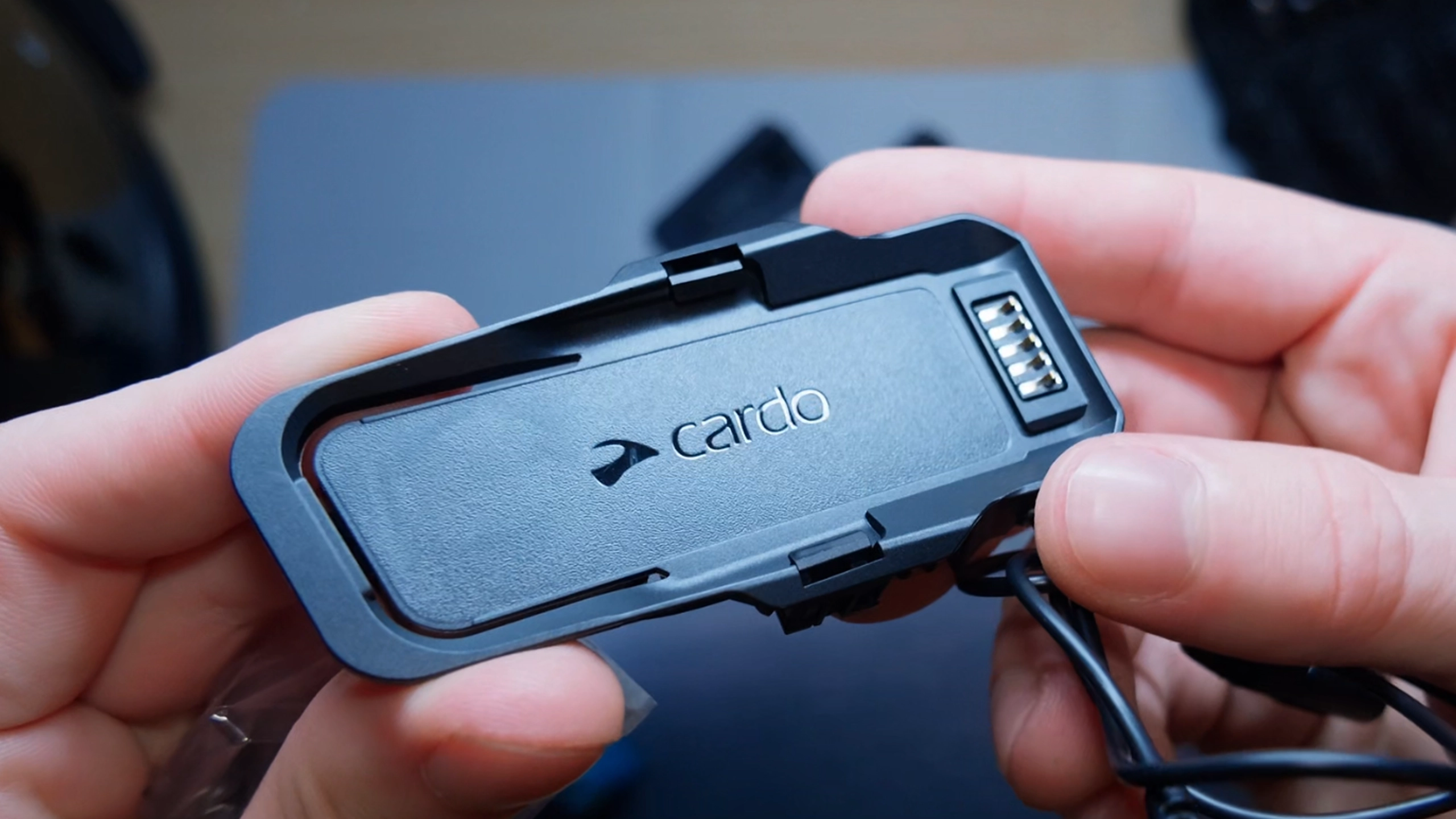
2nd generation Dynamic Mesh Communication
Cardo's DMC mesh is the standout feature and the main reason riders choose the Edge over simpler Bluetooth-only intercoms. Instead of pairing devices one-to-one, mesh creates a self-healing network. Up to 15 riders can join a group, and if one rider drops out of range, the rest of the chain stays live. When they come back into range, they reconnect automatically with zero input. On a group ride through twisty roads where you regularly lose line of sight, this is a material advantage over standard Bluetooth intercom, where a dropped connection usually means pulling over to re-pair.
No external antenna
Earlier Packtalk models had a visible aerial sticking out of the unit. The Edge integrates the antenna into the body, which makes the whole package slimmer, more aerodynamic and less likely to catch on jacket collars or snag when you pull your helmet off.
Cross-brand compatibility
The Packtalk Edge now supports Bluetooth intercom connections with other major brands, including Sena devices. You lose some of the mesh benefits (the cross-brand connection runs over Bluetooth, not DMC), but the core ability to have a conversation with someone on a different brand is now there. The OBI (Open Bluetooth Intercom) standard means you no longer need everyone on the same system.
Full Specifications
Connectivity
| Bluetooth | 5.2 |
| Intercom | 2nd gen Dynamic Mesh Communication (DMC) |
| Group Size | Up to 15 riders (Mesh) |
| Range | Up to 1.6 km rider-to-rider |
| Cross-brand | Yes, via Bluetooth (Sena and others) |
| FM Radio | Yes, with RDS |
Audio
| Speakers | 40mm JBL with three audio profiles |
| Microphone | Hybrid boom/wired (interchangeable) |
| Voice Control | Natural Voice Operation ("Hey Cardo") |
| Noise Control | Active noise cancellation |
Battery and Charging
| Battery Life | Up to 13 hours talk time |
| Charge Time | ~1.5 to 2 hours (USB-C) |
| Fast Charge | 20 min = 2 hours ride time |
| Standby | Up to 10 days |
| Battery Type | Lithium Polymer |
Build and Mounting
| Mounting | Magnetic Air Mount with clamp and adhesive options |
| Waterproofing | IP67-rated confidence (warranty backed) |
| Material | Polycarbonate |
| Weight | ~56g (unit only) |
| Updates | Over-the-air via Cardo Connect app |
| Warranty | 3 years |
Pricing
| UK RRP (single) | ~£356.95 |
| UK RRP (duo) | ~£635 |
Unboxing and First Look
Performance in Use
Sound quality
The 40mm JBL speakers are genuinely good. Not "good for a helmet intercom" good. Actually good. Music has a real low end, podcasts come through clearly, and intercom voices at speed sound like the other person is in your helmet rather than on a bad phone connection. Three audio profiles let you tune the EQ depending on whether you prioritise bass, balanced sound or voice clarity.
At motorway speed with earplugs in, the audio still cuts through with enough detail that you can follow a conversation or enjoy a playlist. The automatic volume adjustment raises output as road noise increases, and while it is not perfect (it can occasionally overcompensate on a gusty day), it works well enough that you rarely touch the volume manually once you have set your baseline.
Voice commands
The "Hey Cardo" wake phrase works surprisingly well. Riders consistently report around 95% accuracy with Natural Voice Operation. You can answer calls, skip tracks, check battery level and start or stop the intercom without lifting a finger. In practice, it takes a couple of rides to learn the exact phrases the system responds to, but once it clicks it genuinely reduces distraction.
Battery life
Cardo quotes 13 hours of talk time. Real-world use confirms that you will comfortably get a full day of touring out of a single charge, even with music and intercom running simultaneously. On a 10 to 12 hour ride day, you should still have charge remaining at the end. The USB-C fast charge is a welcome addition: 20 minutes plugged in gives you roughly two hours of ride time, so even a quick top-up over a coffee stop can rescue you on a multi-day trip.
Range
Cardo claims up to 1.6 km (roughly one mile) of rider-to-rider range. In reality, range depends heavily on terrain, obstructions and line of sight. On open roads you will approach that figure. On twisty rural lanes with hedgerows and dips, expect more like 800 m to 1 km before the signal starts to break up. With four riders in a mesh chain, the total chain range extends to around 4.8 km between the first and last rider.
Connectivity and the App
The Cardo Connect app (free on iOS and Android) is where you manage settings, run firmware updates and fine-tune the unit. It handles intercom and phone volume independently, lets you adjust mic sensitivity, toggle audio profiles, set up speed-sensitive volume and control Bluetooth audio mixing between music and intercom. Over-the-air firmware updates are genuinely convenient. No cables, no laptop, just a prompt in the app and a five-minute wait.
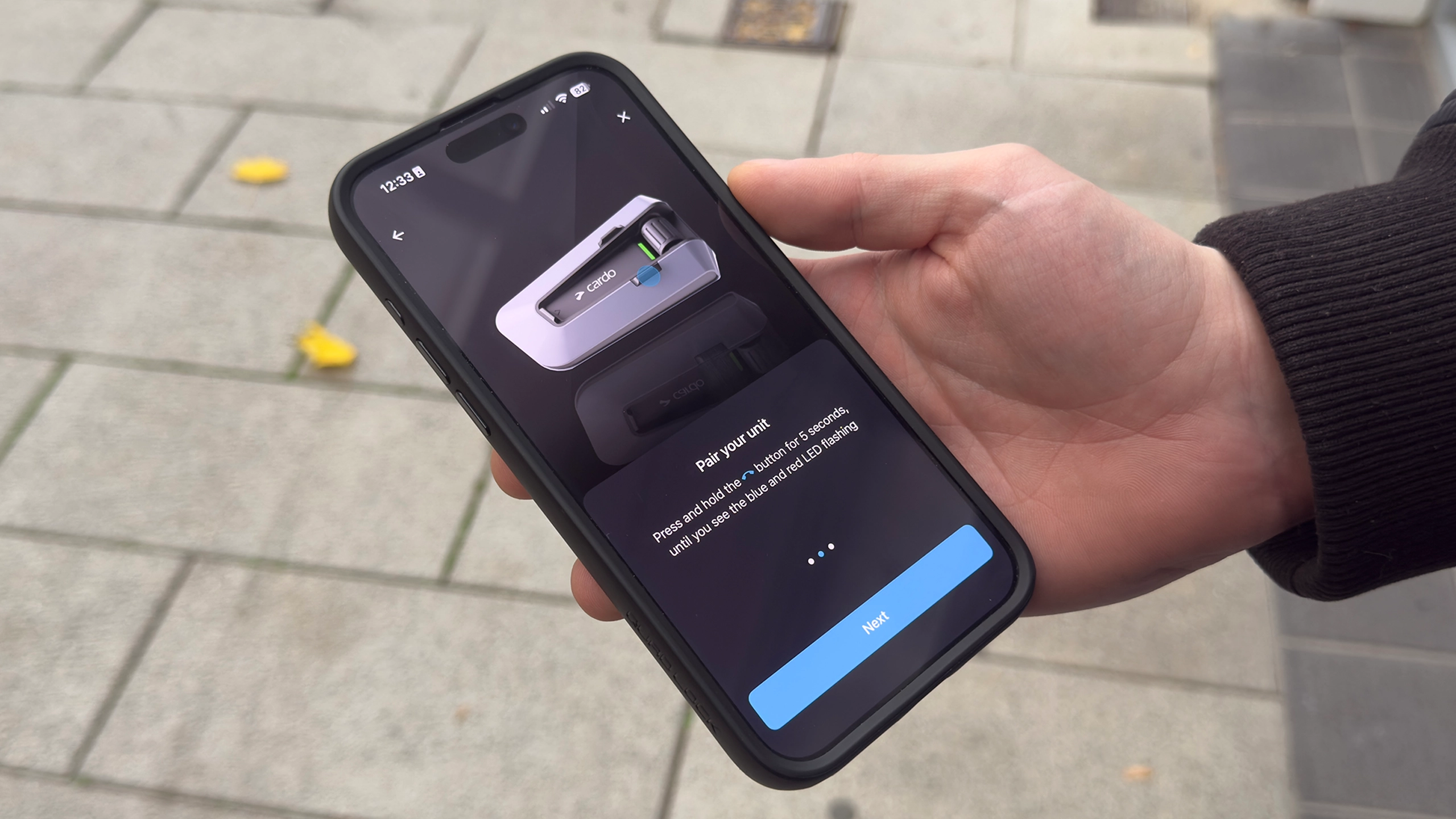
That said, the app is not without its frustrations. Connection reliability between the app and the unit can be temperamental, particularly on Android. Some users report the app failing to recognise the Edge even when Bluetooth is connected. Cardo pushes regular updates that have improved stability, but it is the one area where the experience does not match the polish of the hardware. On iOS, the experience tends to be smoother overall.
Build Quality and Design
The Edge feels premium. The polycarbonate body is tough and compact, noticeably slimmer than the older Packtalk Bold. Buttons are tactile enough to operate with winter gloves, and the scroll wheel gives satisfying physical feedback for volume and channel switching.
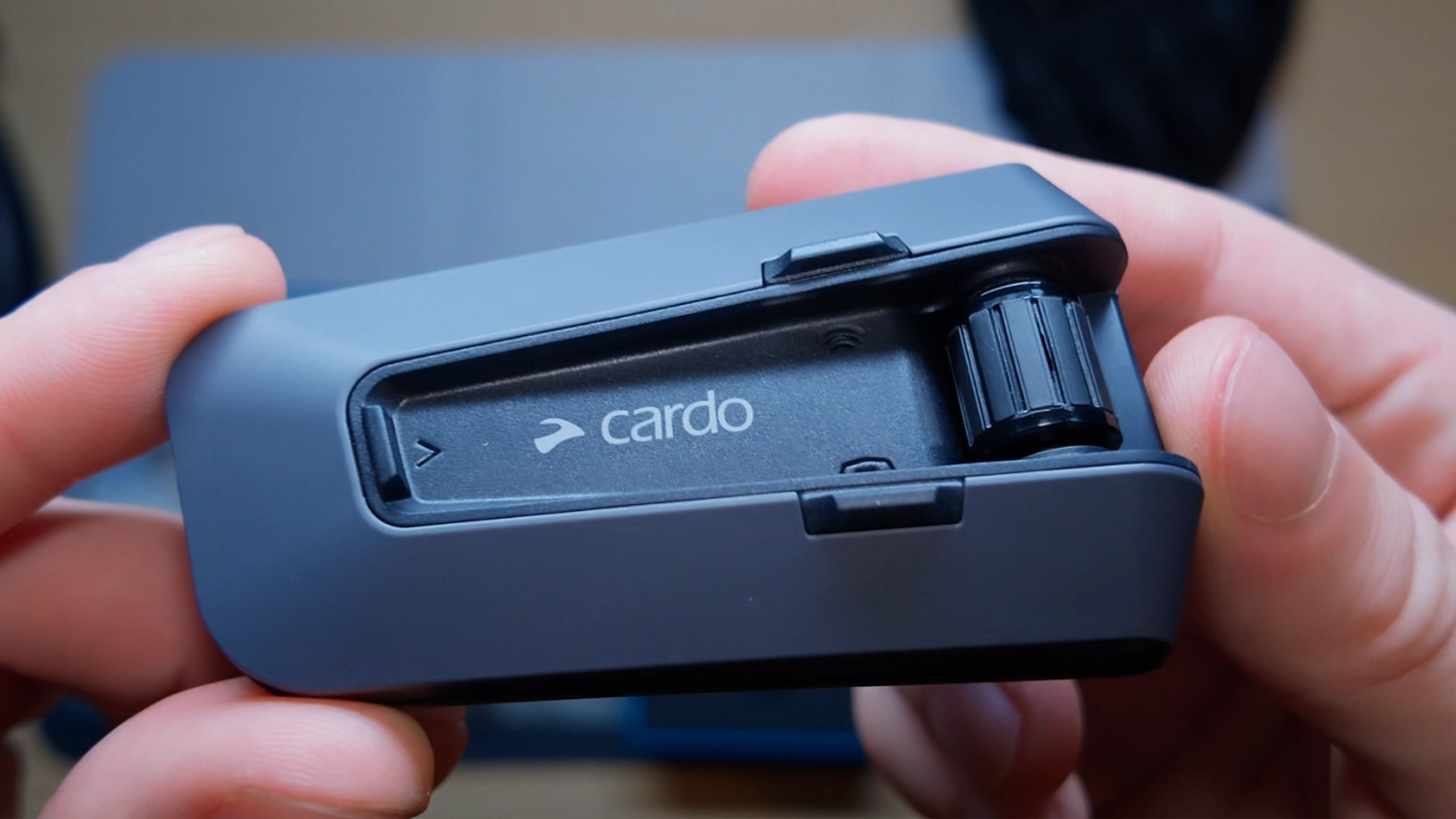
The waterproofing is the standout detail. Cardo is confident enough in the Edge's weather resistance to state that they will replace the unit if it fails due to water ingress. For UK riders, where "waterproof" is not a feature but a prerequisite, this matters.
The wiring loom for the speakers and mic is well-routed, with enough length to fit neatly inside most helmets. The hybrid boom and wired mic options cover full-face, modular and open-face lids. The included kit provides both clamp and adhesive mounting options.
Price vs the Competition
At around £357 for a single unit (or roughly £635 for a duo pack), the Packtalk Edge sits at the premium end of the market. Compared to the Sena 50S, the Edge offers better waterproofing, a more elegant mounting system, superior voice control accuracy and wireless firmware updates. The Sena counters with a slightly longer Bluetooth-only battery life, Harman Kardon speakers, and a broader existing user base. Both are excellent devices.
Against the step-up Cardo Packtalk Pro, the Edge gives up crash detection, the auto on/off feature and 45mm speaker option but saves you around £100. For most riders, the Edge hits the sweet spot between features and price in the Cardo range.
How It Compares
 Cardo Packtalk Edge |
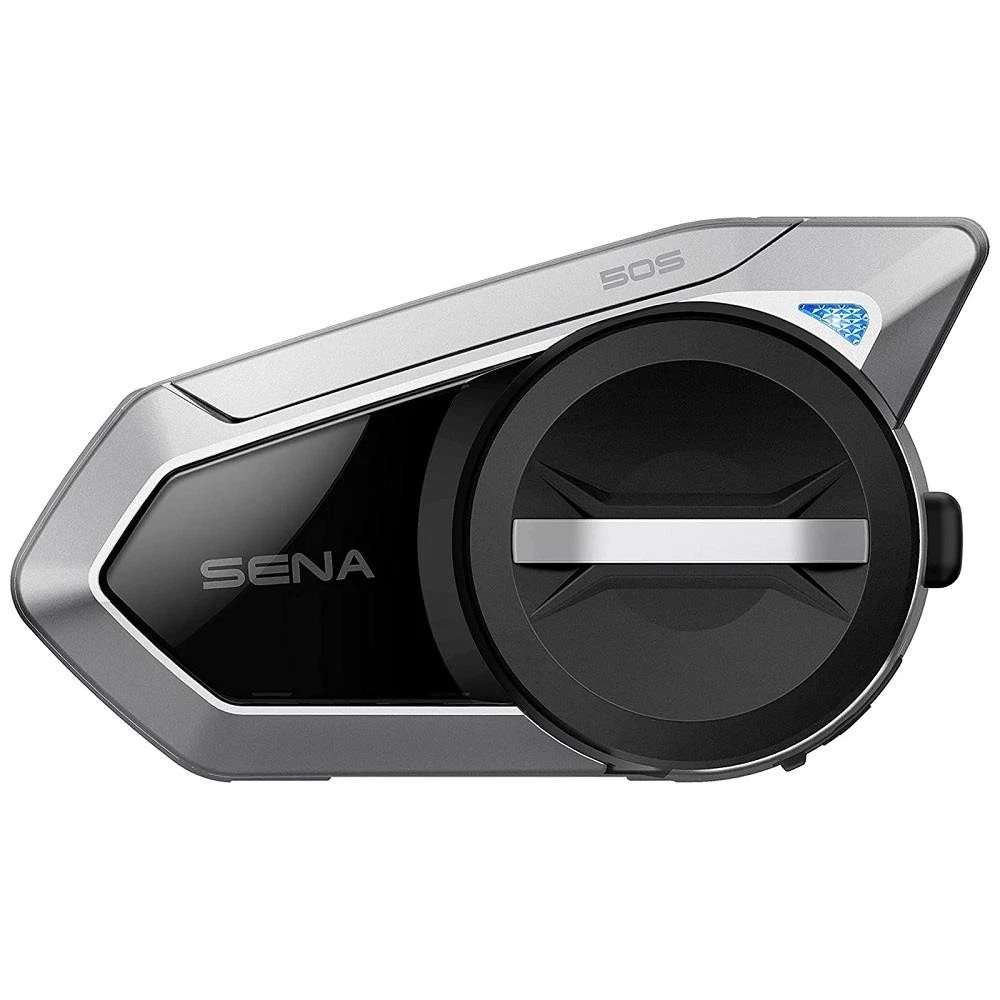 Sena 50S |
 Sena 20S Evo |
|
|---|---|---|---|
| UK Price (single) | ~£357 | ~£279 to £329 | ~£200 to £220 |
| Bluetooth | 5.2 | 5.0 | 4.1 |
| Intercom Type | DMC Mesh + BT | Mesh 2.0 + BT | Bluetooth only |
| Group Size | Up to 15 | Up to 24 | Up to 8 |
| Speakers | 40mm JBL | Harman Kardon | HD speakers |
| Battery Life | 13 hours | 14 hr (BT) / 9 hr (Mesh) | 13 hours |
| Range | 1.6 km | 2 km (Mesh up to 8 km) | 2 km |
| Mounting | Magnetic Air Mount | Slide-in cradle | Clamp mount |
| Waterproofing | IP67 (warranty backed) | Water resistant (no IP) | IP67 |
| Voice Control | "Hey Cardo" (~95%) | Voice + assistant | Voice command |
| OTA Updates | Yes | No (USB) | No (USB) |
| Warranty | 3 years | 2 years | 2 years |
What Could Be Better
No product is perfect. The Cardo Connect app's connection reliability is the biggest gripe. When it works, it is excellent. When it refuses to find your unit, it is infuriating. Cardo has improved this through updates, but it still falls short of the seamless experience the hardware deserves.
Battery level reporting only shows in 25% increments rather than a precise percentage. Finer granularity would be welcome, especially on multi-day trips where you want to plan your charging.
The price is a barrier. At over £350 for a single unit and over £600 for a pair, this is a serious investment. If you ride solo and just want music and nav prompts, there are practical alternatives at half the price that will do the job. The Edge earns its price on group riding, build quality and the overall polish of the experience, but you need to ride in a way that takes advantage of those features to justify the spend.
Finally, the intercom range, while competitive, does not blow the doors off. In hilly or built-up areas, you will feel the limits before the claimed 1.6 km. This is true of all systems at this price point, but it is worth managing expectations.
Who Is It For?
The Cardo Packtalk Edge is best suited to riders who ride in groups, tour regularly with a pillion or simply want high-quality audio and reliable hands-free communication in their helmet. If you frequently ride with three or more others, the mesh connectivity is worth the premium on its own. Touring riders will appreciate the battery life, waterproofing and over-the-air updates. Commuters who listen to podcasts or music daily will notice the JBL speaker quality.
If you ride exclusively solo and never use an intercom, there are more cost-effective ways to get audio into your lid. But for anyone who values communication, build quality and a system that works in all conditions, the Edge is hard to beat at this level.
The Verdict
The Cardo Packtalk Edge is a premium helmet intercom that earns its price through excellent audio, reliable mesh connectivity, clever design (that magnetic mount is a game changer) and a waterproof build that UK riders can actually trust. The app needs improvement and the price will not suit every budget, but the overall package is the best in class for riders who want a system they can rely on without thinking about it. It does what it promises, and it does it well.
