

How to hold the council accountable when a road defect bends your rim or bins your bike.
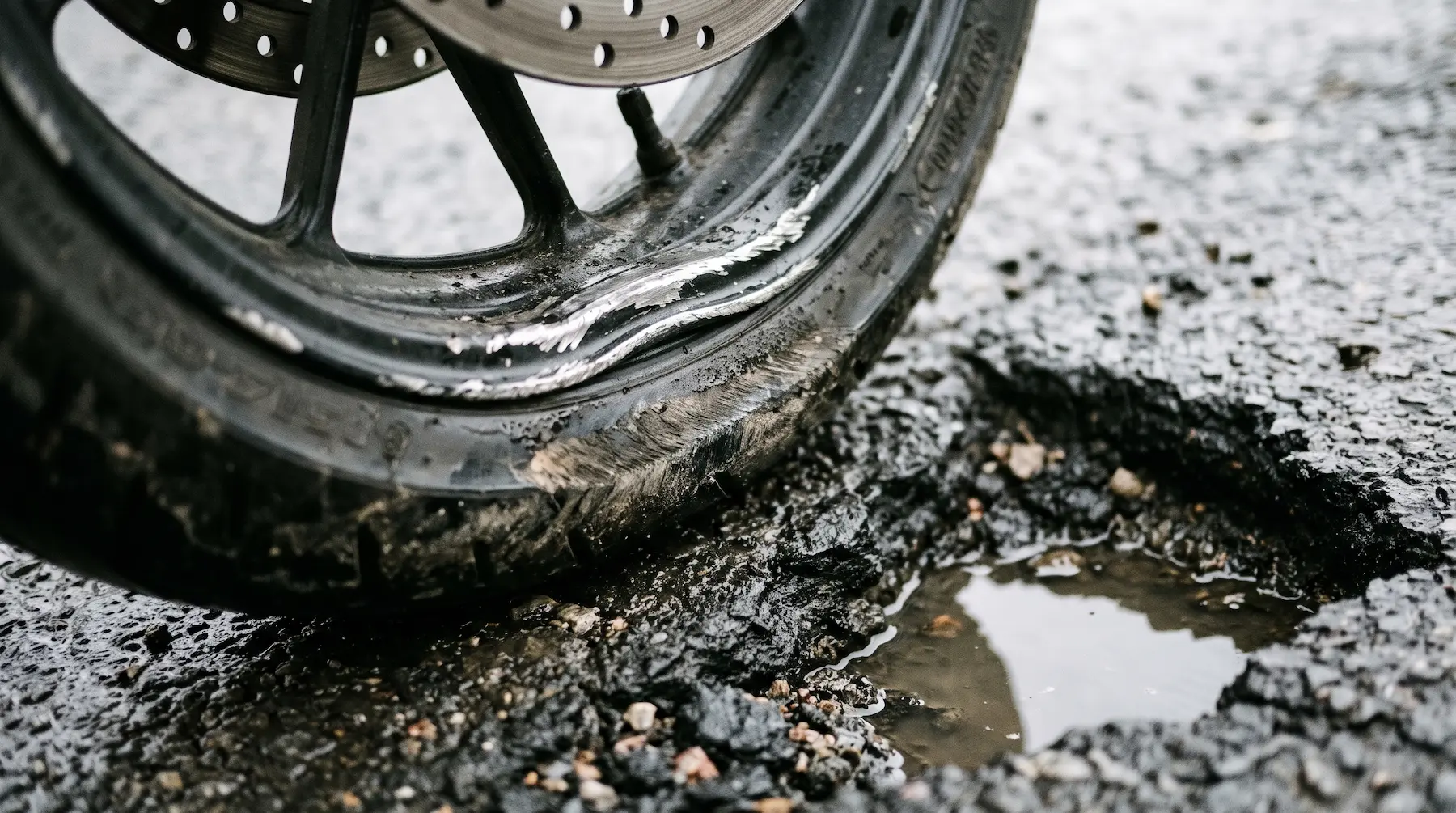
If you hit a crater in a car, you get a jarring clunk, a spilled coffee, and maybe an alignment issue. Hit that exact same pothole on a motorbike, and you’re looking at a buckled alloy wheel, blown fork seals, shredded tyres, or a terrifying high-side across the tarmac.
With UK road maintenance budgets stretched thin, our tarmac looks more like the surface of the moon than ever before. But when road neglect wrecks your bike, getting the local authority to pay for the damage is notoriously difficult. If you’re looking to make a pothole damage motorcycle claim uk councils won't just roll over and hand you a cheque.
To get your repair costs covered, you need to understand how the law works and how to dismantle the council's favourite legal excuse.
The Law: Council Duty vs The Dreaded "Section 58" Defence
Under Section 41 of the Highways Act 1980, local highway authorities (or National Highways for motorways and major trunk A-roads) have an absolute statutory duty to maintain the road network to a safe standard.
Sounds open and shut, right? Not quite.
Councils almost universally protect themselves using Section 58 of the Highways Act 1980. This clause gives authorities a statutory defence against damage claims if they can prove that:
- They had a reasonable system of routine road inspections in place (guided by the national Well-managed Highway Infrastructure code of practice).
- The specific road was inspected according to that schedule.
- At the time of the last inspection, the defect didn’t meet their intervention criteria (usually a depth of 40mm for carriageways) or hadn’t formed yet.
- Nobody had reported the defect to them prior to your incident.
In plain English: if the council can prove they didn’t know the crater was there, they aren’t legally liable for your cracked rim. To win a claim, you have to prove they either knew—or reasonably should have known—about the danger and failed to fix it.
Building An Iron-Clad Case: Evidence You Need Right Away
If you’ve hit a pothole and your bike is damaged, do not just ride home and send an angry email. Councils reject the vast majority of first-time claims with standard boilerplate letters. You need undeniable proof:
- Photographic Evidence (Done Safely): Never step into live traffic or blind bends to snap pictures. When safe, take close-ups of the defect using an everyday item (a coin, key, or tape measure) to show depth and width. Then, take wide-angle context shots showing surrounding landmarks, road signs, or junction markings so the location cannot be disputed.
- Check the Reporting History: Check public defect maps like FixMyStreet or the local council’s online reporting tracker. If another motorist reported that exact pothole three weeks before you hit it, the council’s Section 58 defence completely crumbles.
- Submit a Freedom of Information (FOI) Request: Under the Freedom of Information Act 2000, you are legally entitled to request the council's road inspection logs, maintenance records, and complaint histories for that specific stretch of road for the preceding 12 to 24 months. If their records show missed inspection dates or ignored warnings, your claim has teeth.
- Professional Mechanic Assessment: Take your bike to a reputable workshop for an itemised repair estimate. Ask the technician to specifically note that the buckled rim, flat-spotted tyre, or blown fork seal is consistent with high-energy impact damage from a road defect.

Council Claim vs Insurance: Which Road Should You Take?
When you’re staring at an £800 bill for a new front wheel and tyre, you face a dilemma: do you pursue the council directly, or claim through your motorbike insurance?
Here is how to weigh it up:
1. Pursuing the Council Directly (Uninsured Loss)
- The Reality: Council claims can take anywhere from 3 to 12 months. Their legal departments rely heavily on attrition—hoping you give up after receiving their first automated rejection letter citing Section 58.
- The Advantage: If you win, the council pays for your repairs directly without you having to pay your policy excess or registering a claim against your record.
- Best For: Isolated wheel and tyre damage where the bike is otherwise rideable, the repair costs are manageable out of pocket, and you have time to wait for a settlement.
2. Claiming Through Your Motorbike Insurance
- The Reality: If you have Comprehensive cover, pothole damage is treated as accidental damage. Your insurer handles the repair bill quickly so you can get back out on the bike.
- The Caveat (Fault vs Non-Fault): Until your insurer recovers the repair money from the council, the claim is logged as an open "fault" incident, meaning you must pay your excess upfront and your No Claims Discount (NCD) may be temporarily affected. Once your insurer proves council liability and recovers the payout, your excess is refunded and your NCD restored.
- Best For: Major incidents. If hitting the crater caused a crash, bent the forks, cracked the frame, or shredded your riding kit, going through your insurer gets your bike repaired and back on the road fast.
This is where having the right cover in place pays dividends. Choosing an all-in policy like BeMoto’s Titanium Cover means you get full UK breakdown recovery if you’re stranded at the roadside with a ruined rim, alongside £1,500 Helmet & Leathers protection and personal accident cover bundled as standard.
Plus, our Peterborough-based UK specialist team rides bikes themselves; we understand that hitting a trench in the road isn't "careless riding", and we fight to make sure you’re treated fairly.
Final Thought
Potholes are a massive hazard for UK bikers, but you don't have to take council neglect lying down. The law requires them to maintain our roads, and while Section 58 is their favourite shield, it isn't bulletproof.
Document the scene, grab the reporting logs, hit them with an FOI request, and make sure your bike is backed by specialists who speak your language. Stay sharp, scan the tarmac ahead, and keep the rubber side down!